

How Do You Prepare for Due Diligence? A Business Checklist
How to prepare for due diligence with a practical checklist for organizing, verifying, and presenting business documents. Discover how document accuracy, financial consistency, and transparency build trust with investors, buyers, and lenders.
published:

- 30
- 881
- 9
Introduction to Due Diligence Preparation
Due diligence preparation is a systematic process that enables businesses to gather, verify, organize, and present their financial, legal, and operational information in a clear and transparent manner. This process facilitates informed decision-making by external parties such as investors, acquirers, or lenders. It directly influences the perception of a business's credibility, reliability, and overall value. The primary objective of due diligence preparation is to ensure that all relevant information is accurate, complete, and readily available, reducing the risk of misunderstandings or misrepresentations that could jeopardize potential transactions or relationships.
The concept of due diligence preparation is rooted in corporate governance, financial transparency, and operational accountability. It involves a thorough review and analysis of a company's financial statements, corporate documents, contracts, and operational records to identify inconsistencies, gaps, or areas of concern that could impact the business's valuation, profitability, or sustainability. By addressing these issues proactively, businesses demonstrate their commitment to transparency, accountability, and good governance, enhancing their reputation and attractiveness to external stakeholders.
Due diligence refers to the exhaustive process of reviewing and verifying the accuracy of a company's financial, legal, and operational information. It is essential for mergers and acquisitions, initial public offerings, lending decisions, and other business transactions involving sensitive information. The due diligence process typically involves examining a company's financial statements, including its balance sheet, income statement, and cash flow statement, as well as its corporate governance structure, contracts, and operational records.
Effective due diligence preparation provides context, clarity, and transparency to facilitate informed decision-making. It demonstrates a company's commitment to accountability, governance, and sustainability.
Operationally, due diligence preparation involves reviewing a company's internal controls, risk management practices, and compliance procedures to ensure they are adequate, effective, and aligned with industry best practices. This includes examining financial reporting processes, internal audit functions, and regulatory compliance procedures to identify areas of weakness or non-compliance. By addressing these issues, businesses can mitigate potential risks, enhance operational efficiency, and improve competitiveness.
Inadequate due diligence preparation can lead to reputational damage, financial losses, or litigation. When a company fails to provide accurate or transparent information, it can lead to misunderstandings or misrepresentations that damage its reputation, erode stakeholder trust, and result in financial losses. In extreme cases, it can lead to litigation or regulatory action. Therefore, businesses must prioritize due diligence preparation as a critical component of their risk management strategy.
Financial statement consistency and accuracy are crucial in due diligence preparation. Financial statements provide a snapshot of a company's financial performance, position, and cash flows. However, if these statements are inaccurate or incomplete, they can lead to misinterpretations or misunderstandings with serious consequences. Businesses must ensure their financial statements are prepared in accordance with relevant accounting standards, audited regularly, and presented clearly and consistently.
Due diligence preparation is critical for businesses, enabling them to demonstrate their commitment to transparency, accountability, and good governance. By prioritizing due diligence preparation, businesses can mitigate risks, enhance operational efficiency, and improve competitiveness. As the due diligence process evolves, businesses must adopt best practices, invest in digital technologies, and foster a culture of transparency, accountability, and continuous improvement to stay ahead.
The Due Diligence Process: A Step-by-Step Guide to Preparation
Preparing for due diligence involves gathering, verifying, organizing, and presenting business information to facilitate accurate and efficient evaluation by external parties. A well-structured approach is essential for building trust, ensuring transparency, and supporting informed decision-making. This guide outlines the key steps in preparing for due diligence, including document verification, information gap analysis, and utilizing a due diligence checklist.
The process begins with a thorough review of business records, including financial statements, contracts, corporate documents, and operational information. This initial review identifies potential gaps in information, inconsistencies, and areas requiring additional documentation or explanation. Incomplete or inaccurate documentation poses a significant risk, highlighting the need for a systematic approach to document verification and information gap analysis.
- Document Readiness Assessment: Conduct a comprehensive assessment of business records to identify missing documents, inconsistencies, and areas requiring additional documentation or explanation. This step ensures all necessary information is available and easily accessible to reviewers.
- Document Verification: Verify the accuracy and completeness of business records, including financial statements, contracts, and corporate documents. This involves reviewing documents for consistency, currency, and relevance, as well as ensuring all necessary signatures, stamps, or other authentication measures are in place.
- Information Gap Analysis: Identify and address information gaps, including missing records, conflicting information, and unresolved questions. This requires a thorough analysis of business operations, financial performance, and legal compliance to ensure all necessary information is available and accurately presented.
A due diligence checklist is crucial in the preparation process, ensuring all necessary documents and information are included and accurately presented. Typical categories in a due diligence checklist include:
| Category | Description |
|---|---|
| Financial Information | Financial statements, budgets, forecasts, and other financial data |
| Corporate Documents | Articles of incorporation, bylaws, minutes of meetings, and other corporate records |
| Contracts and Agreements | Material contracts, agreements, and other binding obligations |
| Operational Information | Business operations, management structure, and other relevant operational data |
A well-structured due diligence checklist reduces the risk of errors, omissions, or misrepresentations, and enhances transparency and credibility. The benefits of a systematic approach to due diligence preparation include improved transparency, enhanced credibility, and increased confidence among external parties, such as investors, lenders, and acquirers.
- Due Diligence Preparation Framework
- A structured approach to due diligence preparation, including document readiness assessment, document verification, information gap analysis, and utilizing a due diligence checklist
- Document Verification Process
- A systematic process for verifying the accuracy and completeness of business records, including financial statements, contracts, and corporate documents
- Information Gap Analysis
- A thorough analysis of business operations, financial performance, and legal compliance to identify and address information gaps, including missing records, conflicting information, and unresolved questions
Context is critical in due diligence preparation, as it transforms documents into useful evidence for decision-making. Explanations of significant financial changes, contractual obligations, ownership arrangements, and operational conditions help reviewers interpret records accurately and understand their implications. Visual aids like tables, diagrams, and flowcharts can facilitate a clearer understanding of complex business information, reducing the risk of misinterpretation or miscommunication.
The due diligence process requires a systematic approach to preparation, including document verification, information gap analysis, and utilizing a due diligence checklist. By following this approach, businesses can ensure all necessary documents and information are included and accurately presented, reducing the risk of errors, omissions, or misrepresentations, and enhancing transparency, credibility, and confidence among external parties. The next step involves creating a data room, providing a secure and organized platform for storing and sharing confidential business information with external parties.
Preparing for due diligence is crucial for a smooth process. Inadequate preparation can lead to business risk escalation, resulting in significant financial and reputational losses. Effective document management helps mitigate this risk by maintaining accurate, complete, and up-to-date records, reducing errors, inconsistencies, and misinterpretations.
Confidentiality is critical in due diligence preparation. Businesses must protect sensitive information and only share it with authorized parties to prevent severe consequences, including loss of competitive advantage, reputational damage, and legal liabilities. A robust document management system with strict access controls and encryption can help maintain confidentiality and prevent data breaches.
Poor due diligence preparation can have severe consequences, ranging from delayed or failed transactions to significant financial losses. A company that fails to disclose material information or provides incomplete records may be perceived as untrustworthy, leading to a loss of investor confidence and a damaged reputation. Conversely, a well-prepared company can demonstrate its commitment to transparency, accountability, and good governance, enhancing its credibility and attractiveness to investors and stakeholders.
Common Pitfalls to Avoid
Several common pitfalls can derail the due diligence preparation process, including inadequate document management, insufficient confidentiality measures, and poor communication. To mitigate these risks, businesses can establish a centralized document repository, implement access controls and encryption, and designate a team to oversee the due diligence process.
- Inadequate document management, such as incomplete, inaccurate, or outdated records
- Insufficient confidentiality measures, including inadequate access controls, encryption, or data protection policies
- Poor communication, such as unclear or inconsistent messaging, inadequate stakeholder engagement, or insufficient transparency
- Inadequate risk assessment and mitigation strategies, including failure to identify and address potential risks
- Ineffective project management, including inadequate timelines, budgets, or resource allocation
Businesses must prioritize due diligence preparation to minimize potential errors, inconsistencies, and misinterpretations. This involves implementing a comprehensive risk assessment and mitigation strategy, including identifying and addressing potential risks. By doing so, companies can ensure they are well-prepared for the due diligence process and can respond effectively to any issues that may arise.
Effective due diligence preparation has a direct impact on a company's ability to attract investors, complete transactions, and maintain a strong reputation. By avoiding common mistakes, businesses can demonstrate their commitment to transparency, accountability, and good governance, enhancing their credibility and attractiveness to stakeholders.
Avoiding common mistakes in due diligence preparation requires a comprehensive approach that prioritizes document management, confidentiality, and risk assessment. By implementing robust systems and controls, businesses can minimize potential errors and ensure a smooth due diligence process.
Establishing a Sustainable Due Diligence Preparation Framework
A well-structured due diligence framework is essential for businesses to maintain ongoing readiness and facilitate efficient evaluation by external parties. This framework enables organizations to gather, verify, organize, and present business information in a clear and transparent manner, fostering trust and credibility with investors, buyers, lenders, and other stakeholders. A robust document management system is crucial, ensuring the completeness, accuracy, and consistency of business records.
Inadequate due diligence preparation can lead to misinterpreted or incomplete information, resulting in erroneous conclusions and poor decision-making. To mitigate this risk, businesses must develop a scalable and maintainable approach to due diligence preparation, grounded in a deep understanding of document readiness assessment, due diligence preparation checklists, and financial record consistency. This approach enables organizations to present their business information in a logical and coherent manner, facilitating the identification of relationships between financial, legal, commercial, and operational data.
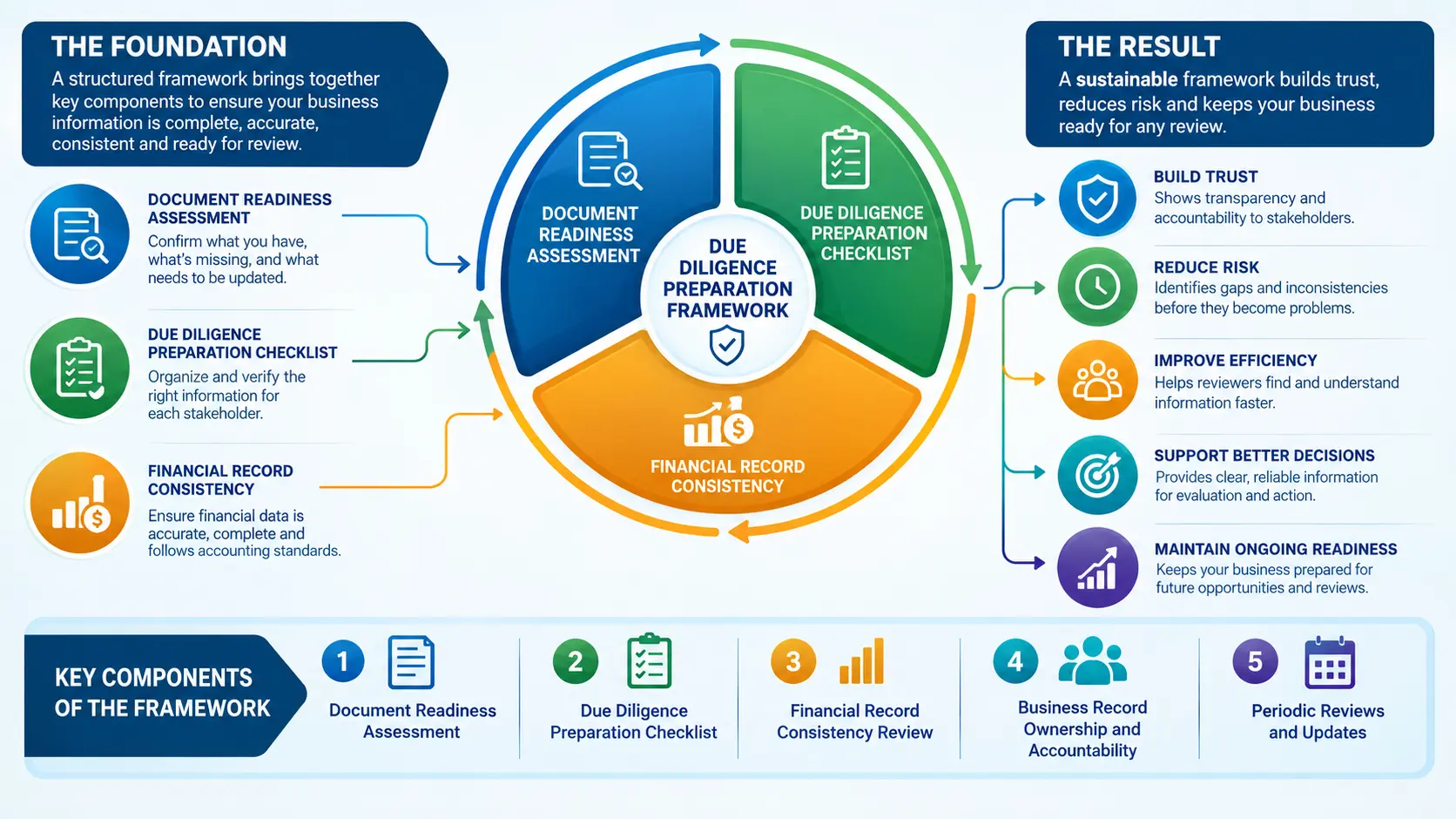
Implementing a due diligence framework requires assigning clear responsibility for records management, periodic reviews, and consistent documentation practices. This enables businesses to respond effectively to investment evaluations, acquisitions, lending decisions, and other external reviews, providing accurate and comprehensive information in a timely manner. Integrating the framework into the organization's governance structure is also critical, ensuring alignment with strategic objectives and risk management strategies.
Due diligence framework development is closely tied to business record ownership, which involves identifying, classifying, and assigning responsibility for managing business records. By establishing clear ownership and accountability, organizations can ensure that documents are handled, stored, and retrieved in a manner that maintains their integrity and authenticity, facilitating the creation of a trusted repository of business information.
Core Components of a Due Diligence Framework
A comprehensive framework comprises several core components: document readiness assessment, due diligence preparation checklist, and financial record consistency review. The document readiness assessment evaluates the completeness, accuracy, and consistency of business records, while the due diligence preparation checklist provides a systematic approach to gathering, verifying, and organizing business information. The financial record consistency review ensures that financial records are accurate, complete, and consistent, conforming to established accounting standards and regulatory requirements.
Integrating these components into a unified framework enables businesses to establish a repeatable and sustainable approach to due diligence preparation, tailored to their specific needs and risk profile. This framework reduces the complexity and cost associated with due diligence preparation, enhancing the transparency and credibility of business information. Ultimately, implementing a due diligence framework is essential for maintaining ongoing readiness and facilitating efficient evaluation by external parties, supporting informed decision-making and fostering confidence among stakeholders.
Key components of a due diligence framework include:
- Document Readiness Assessment
- Due Diligence Preparation Checklist
- Financial Record Consistency Review
- Business Record Ownership and Accountability
- Periodic Reviews and Updates
By prioritizing the development of a comprehensive due diligence framework, businesses can ensure that their due diligence preparation efforts are focused, efficient, and effective, responding to the evolving needs of external parties and maintaining a competitive edge. Implementing a due diligence framework is a strategic imperative, supporting informed decision-making and driving long-term success.
Addressing Common Questions About Due Diligence Preparation
Due diligence preparation involves gathering, verifying, organizing, and presenting business information to facilitate accurate and efficient evaluation by external parties. This process raises several questions, which this section aims to address, providing guidance on best practices and regulatory compliance.
Transparent and well-organized presentation of business information fosters trust among investors, lenders, and other stakeholders, which is essential for securing investments, loans, or facilitating successful mergers and acquisitions.
- What are the key components of due diligence preparation?
- Gathering and verifying all relevant business documents, organizing these documents in a logical and accessible manner, and ensuring that the information presented is accurate, complete, and up-to-date. This process also involves identifying and addressing any gaps or inconsistencies in the information, as well as providing context where necessary.
- How does regulatory compliance impact due diligence preparation?
- Regulatory compliance is crucial, as businesses must ensure that all their operations, financial records, and legal documents comply with relevant laws and regulations. Non-compliance can lead to significant risks, including legal penalties, financial losses, and damage to reputation.
- What is the importance of due diligence requirements in the preparation process?
- Due diligence requirements outline the specific information and documents that need to be prepared and presented. These requirements can vary depending on the nature of the transaction, the industry, and the parties involved. Understanding and fulfilling these requirements is critical to ensuring that the due diligence process is comprehensive and effective.
From an operational perspective, due diligence preparation should be treated as an ongoing discipline. This involves assigning clear responsibility for records management, conducting periodic reviews of business information, and maintaining consistent documentation practices. By adopting such an approach, businesses can respond more effectively to external evaluations, reduce the risk of information gaps or inconsistencies, and enhance their overall credibility and attractiveness to investors and partners.
Due diligence preparation is closely tied to the principle of transparency in business transactions. When businesses are transparent about their operations, financial health, and legal compliance, they demonstrate a commitment to ethical practices and accountability. This transparency is crucial for building trust and confidence among stakeholders, which is key to securing investments, facilitating successful partnerships, and navigating complex regulatory environments.
Due diligence preparation requires careful attention to detail, a deep understanding of regulatory compliance, and a commitment to transparency and accountability. By addressing common questions and concerns related to this process, businesses can better navigate the complexities of due diligence, enhance their credibility, and improve their chances of success in today's competitive and highly regulated business environment.
As the business landscape evolves, with increasing demands for transparency, accountability, and regulatory compliance, the importance of thorough and effective due diligence preparation will continue to grow. Organizations should prioritize this process, investing time and resources into developing robust systems for managing business information, ensuring compliance, and facilitating open communication with stakeholders. By doing so, businesses can mitigate risks and capitalize on opportunities, driving growth, innovation, and success in their respective markets.
Frequently Asked Questions
How does poor due diligence preparation affect a business transaction?
Poor due diligence preparation can delay a transaction, increase the effort required to verify information, and raise concerns about the completeness or reliability of business records. Missing documents, inconsistent financial information, and unexplained issues can reduce reviewer confidence and complicate risk assessment. In serious cases, inaccurate or misleading information may contribute to financial losses, disputes, or legal consequences.
When should a company start preparing for due diligence?
A company should begin preparing before an investor, buyer, lender, or other external party formally requests information. Early preparation provides time to verify records, address missing documents, resolve inconsistencies, and explain material business developments. Maintaining organized and current records as part of normal business operations reduces the burden of preparing for a transaction or external review.
How can a business maintain due diligence readiness over time?
A business can maintain due diligence readiness by assigning responsibility for important records, reviewing documents periodically, correcting inconsistencies, and updating information when circumstances change. Maintain consistent documentation practices and keep relevant financial, corporate, contractual, and operational records organized. Ongoing preparation helps the business respond more effectively when investors, buyers, lenders, or other external parties request information.
How should confidential documents be shared during due diligence?
Confidential documents should be shared only with authorized parties and in accordance with the business's confidentiality obligations and applicable requirements. Establish appropriate access permissions, protect sensitive information, and maintain clear procedures for distributing and updating records. Review what information each party needs before granting access, and avoid exposing confidential business information unnecessarily.
What are the most common due diligence preparation mistakes?
Common mistakes include maintaining incomplete or outdated records, overlooking inconsistencies, failing to identify information gaps, providing insufficient context, and neglecting confidentiality. Poor communication, unclear responsibility for documents, and inadequate preparation timelines can also delay reviews. Businesses can reduce these risks through document verification, a structured checklist, clear record ownership, and a consistent review process.
How does organized information build trust with investors and buyers?
Organized information helps investors and buyers locate supporting evidence, compare related records, identify inconsistencies, and understand a business's financial and operational position. Complete, accurate, current, and clearly presented information demonstrates a commitment to transparency and accountability. Although organization alone cannot guarantee trust or a successful transaction, it helps reviewers evaluate the business and its claims with greater confidence.
Why is context important when preparing documents for due diligence?
Context helps reviewers interpret business documents accurately and understand their implications. Financial statements, contracts, and operational records may not explain the reasons behind significant changes, unusual conditions, or important obligations. Providing relevant explanations helps investors, buyers, and lenders understand the information, assess potential risks, and make better-informed decisions.
How should business documents be organized for due diligence?
Organize business documents into clear categories such as financial information, corporate records, contracts, and operational information. Use consistent naming conventions, distinguish current documents from superseded versions, and ensure that records are accessible to authorized reviewers. Arrange information so reviewers can understand relationships between documents and locate the evidence needed to evaluate the business.
How do you verify financial records before due diligence?
Verify financial records by reviewing financial statements, budgets, forecasts, and supporting information for accuracy, completeness, and consistency. Check that reporting periods, figures, and related records agree, and investigate unexplained discrepancies or significant financial changes. Confirm that statements follow applicable accounting requirements and that supporting documentation is available to substantiate important financial information.
How can a business identify missing information before due diligence begins?
A business can identify missing information by conducting a document readiness assessment and comparing available records against a due diligence checklist. Review financial, legal, corporate, and operational information to find missing documents, conflicting figures, outdated records, and unanswered questions. Assign responsibility for resolving each gap and document any outstanding issues that cannot be resolved before the review begins.
What documents should be included in a due diligence checklist?
A due diligence checklist should cover financial statements, budgets, forecasts, corporate formation documents, governance records, material contracts, agreements, and operational information. Depending on the transaction, additional records may be required to address ownership, legal obligations, regulatory compliance, internal controls, and business risks. The specific checklist should reflect the transaction's purpose, the industry, and the reviewing party's requirements.
How do you prepare business documents for due diligence?
Prepare business documents by assessing what records are available, verifying their accuracy and completeness, identifying missing or conflicting information, and organizing documents into logical categories. Review financial statements, corporate records, contracts, and operational information for consistency and currency. Provide context for significant changes or unresolved issues so investors, buyers, and lenders can evaluate the business accurately.