

How To Use a Virtual Data Room to Present Information to Investors
How a virtual data room for investors helps organize documents with clear context to improve investor due diligence and build trust. Discover best practices for presenting information that reduces questions, accelerates fundraising, and demonstrates operational maturity.
published:

- 28
- 833
- 61
Introduction to Virtual Data Rooms
A virtual data room (VDR) is a digital repository that securely stores and facilitates the sharing of sensitive information, typically during due diligence processes in mergers and acquisitions, fundraising, or other business transactions. The primary purpose of a VDR is to provide a controlled environment where authorized parties can access confidential documents, reducing the risks associated with physical data rooms or unsecured file-sharing methods.
The concept of virtual data rooms has evolved significantly over the years, driven by advances in cloud computing, cybersecurity, and collaboration technologies. Today, VDRs are an essential tool for businesses seeking to communicate complex information to investors, partners, or other stakeholders while maintaining confidentiality and control. A well-structured VDR can streamline due diligence processes, reduce costs, and enhance the overall efficiency of business transactions.
VDRs are often confused with generic file-sharing platforms or cloud storage services. However, they offer a unique set of features designed specifically for secure document sharing and collaboration during high-stakes business transactions. These features typically include access controls, encryption, audit trails, and customizable permissions, which enable administrators to regulate user access and monitor activity within the VDR.
Investors evaluating potential investments require timely and secure access to sensitive information. A virtual data room provides a centralized platform for sharing documents, reducing the risk of data breaches and ensuring that all stakeholders have equal access to critical information.
From an operational perspective, VDRs play a critical role in facilitating effective communication between businesses and their investors. By providing a structured and secure environment for document sharing, VDRs enable companies to present their financial and operational performance in a clear and transparent manner, which is essential for building trust with potential investors. A well-organized VDR can also help reduce the time required for due diligence, as all relevant information is readily available and easily accessible.
Key Components of Virtual Data Rooms
A virtual data room typically consists of several key components, including a document repository, access control system, and collaboration tools. The document repository is the central storage location for all sensitive documents, which can be organized into folders and subfolders to facilitate easy navigation. Access controls, such as user authentication and authorization, ensure that only authorized parties can access the VDR and view specific documents.
The collaboration tools integrated into a VDR enable users to interact with each other and with the documents in a secure and controlled environment. These tools may include features such as messaging, Q&A forums, and document annotation, which facilitate communication and feedback between stakeholders. By providing a platform for real-time collaboration, VDRs can help accelerate due diligence processes and reduce the need for physical meetings or email exchanges.
Due diligence is a critical component of any business transaction, involving a thorough review of a company's financial, legal, and operational performance. A virtual data room plays a vital role in facilitating due diligence by providing a centralized platform for document sharing and collaboration. By ensuring that all stakeholders have access to the same information, VDRs can help reduce the risk of miscommunication or misunderstandings, which can derail business transactions.
The secondary risk factor associated with virtual data rooms is the potential for security breaches or unauthorized access. To mitigate this risk, VDR providers typically implement robust security measures, including encryption, firewalls, and intrusion detection systems. Additionally, administrators can configure access controls to regulate user permissions and monitor activity within the VDR, further reducing the risk of security incidents.
Benefits of Virtual Data Rooms for Investor Communication
VDRs offer numerous benefits for businesses seeking to communicate complex information to investors. One of the primary advantages is enhanced security, as VDRs provide a controlled environment for document sharing and collaboration. This reduces the risk of data breaches or unauthorized access, which can have severe consequences for businesses and their stakeholders.
Another significant benefit of virtual data rooms is improved efficiency. By providing a centralized platform for document sharing and collaboration, VDRs can streamline due diligence processes, reducing the time required for investors to evaluate potential investments. This, in turn, can accelerate business transactions and enhance the overall efficiency of the investment process.
From a business perspective, virtual data rooms can also help build trust with potential investors. By providing a transparent and secure environment for document sharing, VDRs demonstrate a company's commitment to confidentiality and control. This can enhance the credibility of the business and its management team, making it more attractive to investors.
Investor communication is critical for businesses seeking to attract investment or facilitate business transactions. Virtual data rooms play a vital role in this process by providing a secure and controlled environment for document sharing and collaboration. By leveraging VDRs, businesses can ensure that sensitive information is communicated effectively to investors, reducing the risk of miscommunication or misunderstandings.
Virtual data rooms are an essential tool for businesses seeking to communicate complex information to investors while maintaining confidentiality and control. By understanding the key components and benefits of VDRs, companies can leverage these platforms to streamline due diligence processes, build trust with potential investors, and enhance the overall efficiency of business transactions. As the use of virtual data rooms continues to evolve, it is likely that they will become an increasingly important component of investor communication strategies.
Learn More About Virtual Data Rooms
Best Practices for Organizing Investor Documents in a Virtual Data Room
The organization of investor documents within a virtual data room is a critical aspect of the fundraising process, as it directly impacts the efficiency and effectiveness of due diligence. A well-structured approach to document organization enables investors to quickly locate and understand relevant information, thereby reducing the time required for evaluation and increasing confidence in the business. From an operational perspective, the primary goal of investor document organization is to present a logical narrative that showcases the company's performance, growth potential, and risk factors in a clear and concise manner.
A key consideration in organizing investor documents is the establishment of a standardized taxonomy that categorizes and prioritizes information based on its relevance and importance. This can be achieved through the creation of a hierarchical folder structure that segregates documents into distinct categories, such as corporate governance, financial performance, and operational metrics. By utilizing a consistent naming convention and applying clear descriptions to each category, businesses can ensure that investors can easily navigate the virtual data room and locate specific documents without undue effort.
- Corporate Governance: This category should include documents related to the company's ownership structure, board composition, and executive leadership team, such as articles of incorporation, bylaws, and organizational charts.
- Financial Performance: This category should contain financial statements, such as balance sheets, income statements, and cash flow statements, as well as management discussion and analysis (MD&A) reports that provide context and insight into the company's financial performance.
- Operational Metrics: This category should include documents that showcase the company's operational performance, such as key performance indicators (KPIs), customer acquisition costs, and retention rates.
Another critical aspect of investor document organization is the application of access controls and permissions to ensure that confidential information is protected and only shared with authorized parties. This can be achieved through the implementation of role-based access controls that restrict access to specific documents or categories based on an individual's role or affiliation. By applying these controls, businesses can maintain confidentiality and control over sensitive information while still providing investors with the necessary information to conduct thorough due diligence.
| Document Category | Access Level | Description |
|---|---|---|
| Corporate Governance | Public | Documents related to the company's ownership structure and leadership team. |
| Financial Performance | Confidential | Financial statements and management discussion and analysis (MD&A) reports. |
| Operational Metrics | Restricted |
The secondary risk factor associated with poorly organized investor documents is the potential for misunderstandings or misinterpretations of critical information. When investors are unable to locate or understand relevant documents, they may draw incorrect conclusions about the business, which can negatively impact their investment decision. To mitigate this risk, businesses should prioritize clarity and transparency in their document organization, providing clear descriptions and summaries of complex information and ensuring that all documents are up-to-date and accurate.
- Investor Document Organization Framework
- A structured approach to organizing investor documents that prioritizes clarity, transparency, and confidentiality. This framework should include the following components:
- Standardized taxonomy for categorizing and prioritizing information.
- Clear descriptions and summaries of complex information.
- Access controls and permissions to protect confidential information.
By implementing a well-structured approach to investor document organization, businesses can demonstrate their operational maturity and commitment to transparency, which can strengthen trust with investors and ultimately support successful fundraising efforts. From a practical perspective, this requires careful consideration of the taxonomy, access controls, and clarity of information presented within the virtual data room. As such, it is essential for executives to prioritize investor document organization as a critical component of their fundraising strategy, recognizing that effective communication and transparency are essential for building trust and securing investment.
Learn More About Virtual Data Rooms
Avoiding Common Mistakes in Investor Communication and Document Sharing
Effective investor communication is crucial for successful fundraising, as it directly influences the perception of a company's professionalism and operational maturity. However, many organizations approach investor due diligence as a mere document-sharing exercise, rather than a structured communication process. This oversight can lead to a plethora of issues, including unnecessary questions, prolonged due diligence, and reduced confidence in management's preparedness. To mitigate these risks, it is essential to identify and avoid common mistakes in investor communication and document sharing.
The primary risk factor in investor communication is the lack of context and clarity in presented information. Investors often receive large collections of files with little explanation, inconsistent organization, missing context, and unclear relationships between documents. This increases the time required to evaluate an opportunity, creating unnecessary questions and slowing fundraising activities. From an operational perspective, this lack of clarity can be attributed to inadequate document management and insufficient communication strategies. Businesses must prioritize the development of a structured approach that presents information in a logical narrative, allowing investors to understand the business efficiently while maintaining appropriate confidentiality and control.
Common Mistakes in Investor Communication
- Inadequate document organization and indexing, leading to difficulties in locating specific information
- Insufficient context and explanations, resulting in misunderstandings and misinterpretations of presented data
- Failure to provide clear and concise summaries of complex information, overwhelming investors with unnecessary details
- Inconsistent formatting and naming conventions, creating confusion and making it challenging to compare documents
- Lack of transparency and accountability, eroding trust and confidence in management's preparedness and decision-making capabilities
The secondary risk factor in investor communication is the failure to provide timely and relevant updates, leading to a lack of transparency and accountability. Investors require regular progress reports and clear communication regarding significant developments, such as changes in management or shifts in business strategy. From a tactical perspective, businesses must establish a reliable and efficient communication channel, ensuring that investors receive accurate and up-to-date information in a timely manner. This can be achieved through the implementation of a robust document management system, enabling real-time updates and collaboration.
Best Practices for Investor Communication
- Develop a structured approach to document management, ensuring that all necessary information is presented clearly and concisely
- Establish a reliable and efficient communication channel, providing timely and relevant updates to investors
- Prioritize transparency and accountability, maintaining open lines of communication and addressing investor concerns promptly
- Utilize tables and checklists to present complex information in a clear and concise manner, facilitating easier comparison and analysis
- Conduct regular reviews and updates of documentation, ensuring that all information remains accurate and relevant
In conclusion, avoiding common mistakes in investor communication and document sharing is crucial for successful fundraising. By prioritizing clarity, transparency, and accountability, businesses can establish trust with investors, reduce unnecessary questions, and accelerate the due diligence process. The implementation of a structured approach to document management and communication strategies is essential, enabling companies to present information in a logical narrative and maintain appropriate confidentiality and control. As the investor due diligence process continues to evolve, it is imperative that businesses adapt and refine their communication strategies, ensuring that they remain competitive and attractive to potential investors.
From a decision-making perspective, management teams must recognize the importance of effective investor communication, prioritizing the development of robust document management systems and communication channels. By doing so, companies can mitigate risks, reduce costs, and increase their chances of securing funding. The following checklist provides a framework for evaluating the effectiveness of an organization's investor communication strategy:
Investor Communication Strategy Evaluation Checklist
- Is the document management system robust and efficient, providing timely and relevant updates to investors?
- Are communication channels reliable and transparent, maintaining open lines of communication and addressing investor concerns promptly?
- Is the presentation of information clear and concise, utilizing tables and checklists to facilitate easier comparison and analysis?
- Are regular reviews and updates of documentation conducted, ensuring that all information remains accurate and relevant?
- Is the overall communication strategy aligned with business objectives, prioritizing transparency, accountability, and clarity?
Learn More About Virtual Data Rooms
Building Trust with Investors: The Role of Transparent Information and Context
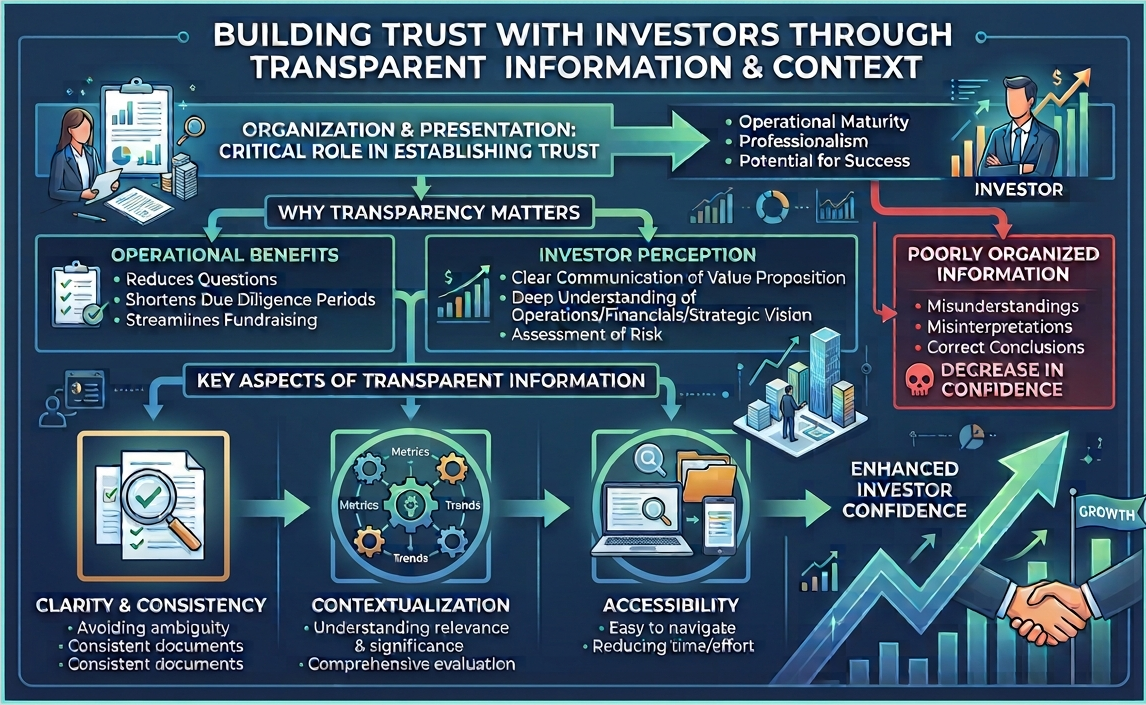
The organization and presentation of business information play a critical role in establishing trust with investors, as it directly influences their perception of the company's operational maturity, professionalism, and ultimately, its potential for success. When investors are presented with clear, well-structured, and contextualized information, they are more likely to develop confidence in the business and its management team. This confidence is rooted in the ability of the organization to communicate complex information effectively, demonstrating a deep understanding of their operations, financials, and strategic vision.
Investor confidence is not solely built on the quality of a business's products or services but also on the clarity and transparency with which they communicate their value proposition, operational efficiency, and growth potential.
From an operational perspective, transparent information and context are essential for reducing unnecessary questions and shortening due diligence periods. When businesses present complete, accurate, and logically structured information that is easy to navigate, investors can efficiently evaluate relationships, decisions, and business performance. This not only streamlines the fundraising process but also demonstrates a high level of professionalism and preparedness on the part of the management team.
The importance of transparent information in building trust with investors cannot be overstated. It is through this transparency that businesses can showcase their corporate governance, ethical standards, and commitment to accountability. A well-structured approach to information presentation allows investors to assess the risk factors associated with an investment more accurately, leading to more informed decision-making. The following key aspects of transparent information are crucial in this context:
- Clarity and Consistency: Information should be presented in a clear, concise manner, avoiding ambiguity and ensuring consistency across all documents and communications.
- Contextualization: Providing context for the information helps investors understand its relevance and significance, facilitating a more comprehensive evaluation of the business.
- Accessibility: Information should be easily accessible and navigable, reducing the time and effort required by investors to find and understand critical data points.
The secondary risk factor associated with poorly organized information is the potential for misunderstandings or misinterpretations of the business's financial health, operational efficiency, or strategic direction. When information lacks clarity or context, investors may draw incorrect conclusions, leading to a decrease in investor confidence and potentially harming fundraising efforts. Conversely, businesses that prioritize transparent and well-structured information presentation are better positioned to build trust with investors, as they demonstrate a commitment to openness, accountability, and professionalism.
From a practical perspective, achieving transparency in information organization requires a structured approach that prioritizes clarity, consistency, and accessibility. Businesses should implement frameworks and checklists to ensure that all critical information is properly documented, updated regularly, and presented in a logical narrative. The following framework illustrates the key components of an effective information organization strategy:
To further guide the implementation of such a strategy, businesses can utilize the following checklist to ensure that their information presentation meets the standards expected by investors:
- Conduct regular audits of all business documentation to ensure accuracy and relevance.
- Implement a consistent formatting and naming convention for all documents.
- Provide clear context for all financial and operational data, including explanations of key metrics and trends.
- Ensure that all information is easily accessible and navigable, both physically and digitally.
Building trust with investors through transparent information and context is a critical aspect of successful fundraising. By prioritizing clarity, consistency, and accessibility in their information presentation, businesses can demonstrate operational maturity, professionalism, and a commitment to accountability, ultimately enhancing investor confidence and supporting their growth objectives.
Learn More About Virtual Data Rooms
Checklist for Preparing Investor-Ready Documentation in a Virtual Data Room
Preparing investor-ready documentation is a critical component of the fundraising process, as it enables investors to efficiently evaluate an opportunity and make informed decisions. A well-structured virtual data room (VDR) can significantly enhance the due diligence process by providing a centralized repository of key documents and information. The following checklist outlines the essential elements that should be included in an investor-ready documentation package to facilitate a smooth and successful fundraising experience.
From an operational perspective, the primary objective of an investor-ready documentation checklist is to ensure that all necessary documents and information are accurately organized, up-to-date, and readily accessible. This involves categorizing documents into distinct sections, such as corporate governance, financial performance, and operational metrics, to enable investors to quickly locate specific information. A comprehensive checklist should also account for the various stakeholders involved in the due diligence process, including investment committees, auditors, and regulatory bodies.
| Category | Description |
|---|---|
| Corporate Governance | Articles of incorporation, bylaws, board meeting minutes, and shareholder agreements |
| Financial Performance | Financial statements, budgets, forecasts, and key performance indicators (KPIs) |
| Operational Metrics | Customer acquisition costs, customer lifetime value, retention rates, and other relevant metrics |
A thorough understanding of the due diligence process is essential for creating an effective investor-ready documentation checklist. Due diligence involves a comprehensive review of a company's financial, operational, and legal information to identify potential risks and opportunities. A well-structured VDR can facilitate this process by providing investors with easy access to relevant documents and information. The following framework outlines the key components of a due diligence checklist:
- Review of financial statements and accounting records
- Analysis of operational metrics and KPIs
- Evaluation of corporate governance and regulatory compliance
- Assessment of intellectual property and technology assets
To ensure that the investor-ready documentation checklist is comprehensive and effective, it is essential to consider the following key factors:
- Accuracy and completeness of documents and information
- Organization and categorization of documents
- Accessibility and usability of the VDR
- Confidentiality and security of sensitive information
The secondary risk factor associated with inadequate investor-ready documentation is the potential for delays or even deal failure due to incomplete or disorganized information. To mitigate this risk, companies should prioritize the creation of a comprehensive and well-structured VDR that provides easy access to relevant documents and information. The following decision checklist can help investment committees evaluate the effectiveness of an investor-ready documentation package:
- Are all necessary documents and information included?
- Is the information accurate, up-to-date, and complete?
- Is the VDR well-organized and easy to navigate?
- Are confidentiality and security measures in place to protect sensitive information?
From a business perspective, the ability to present investor-ready documentation in a clear and organized manner is critical for establishing trust and credibility with potential investors. A well-structured VDR can demonstrate a company's operational maturity and commitment to transparency, which can positively influence investment decisions. As such, companies should prioritize the creation of comprehensive and effective investor-ready documentation checklists to facilitate successful fundraising outcomes.
Frequently Asked Questions
How does an organized virtual data room improve investor due diligence?
Well-organized information reduces the time investors spend searching for documents and clarifying missing information. When documents are presented in a logical structure with clear context, investors can evaluate opportunities more quickly and make better informed decisions.
How do virtual data rooms help build trust with investors?
Virtual data rooms provide a secure environment where information is organized, accessible, and presented consistently. This demonstrates professionalism, supports transparency, and allows investors to evaluate opportunities with greater confidence.
What makes an investor data room easier to navigate?
Clear folder structures, consistent document names, concise summaries, logical document categories, and well-maintained information all contribute to a data room that investors can navigate efficiently during due diligence.
How does document organization influence investor confidence?
Organized information demonstrates operational maturity, attention to detail, and transparency. Investors often view a well-structured data room as evidence that management operates the business with discipline and can effectively communicate important information.
Why should access permissions be part of an investor data room strategy?
Role-based permissions help protect confidential information while ensuring investors receive the documents appropriate for each stage of the fundraising process. This maintains security without slowing collaboration.
What documents should every investor data room include?
An investor data room should include corporate governance documents, financial statements, operational metrics, business performance information, and supporting documentation that explains how the business operates. The information should be complete, current, and organized for efficient due diligence.
How should a virtual data room be organized for investors?
A virtual data room should organize documents into logical categories such as corporate governance, financial performance, and operational metrics. Consistent naming conventions, clear descriptions, and contextual information help investors quickly understand relationships between documents and evaluate the business more efficiently.
What are the biggest mistakes companies make when sharing information with investors?
Common mistakes include providing large collections of files without context, using inconsistent document organization, failing to explain relationships between documents, and allowing outdated or incomplete information to remain available during due diligence.
Why is context more important than simply sharing documents with investors?
Documents alone rarely explain how a business operates or why decisions were made. Providing context through summaries, logical organization, and supporting information helps investors understand the significance of each document, reduces unnecessary questions, and builds confidence in management.
How can businesses reduce investor questions during due diligence?
Businesses can reduce investor questions by organizing documents logically, adding explanations where appropriate, keeping information current, and presenting documents as part of a connected business narrative instead of an isolated collection of files.