

How Does Information Move Through a Business?
How business information moves through creation, collection, review, sharing, storage, and access. Understand how effective information flow improves accuracy, communication, decision-making, and business operations.
published:

- 28
- 833
- 27
Defining Business Information Flow
The concept of business information flow refers to the movement and transformation of information as it passes through various stages, processes, and departments within an organization. This flow is critical to the success of any business, as it directly impacts decision-making, communication, and overall operational efficiency. At its core, business information flow encompasses the creation, collection, transformation, review, approval, sharing, storage, and access of information, highlighting the complex interplay between different components of an organization.
Business information can be understood as any data or knowledge that is relevant to the operations, management, and decision-making processes of an organization. This includes financial data, customer information, operational metrics, strategic plans, and more. The flow of this information through business processes, such as marketing, sales, production, and human resources—determines how effectively an organization can achieve its objectives.
Key Concepts in Business Information Flow
The understanding and management of business information flow hinge on several key concepts. These include information creation, where new data or knowledge is generated; information collection, the process of gathering existing information from various sources; information transformation, which involves converting or manipulating information into a more usable form; and information review and approval, critical steps for ensuring the accuracy, relevance, and security of business information.
- Information Sharing: The dissemination of information to relevant stakeholders within or outside the organization, which is crucial for collaboration, decision-making, and achieving business goals.
- Information Storage and Access: Refers to how information is stored securely and made accessible to authorized personnel when needed, ensuring continuity of operations and supporting business intelligence.
- Information Context and Accuracy: Understanding the context in which information is created and used, and ensuring its accuracy, are vital for making informed decisions and avoiding costly mistakes.
The importance of business information flow cannot be overstated. It underpins every aspect of organizational operations, from strategic planning to day-to-day management. Effective management of this flow helps in mitigating risks such as information silos, duplicate or outdated information, and misunderstandings that can arise from poor communication or lack of context.
Why Business Information Flow Matters
Understanding and optimizing business information flow is essential for improving communication, maintaining organizational knowledge, and facilitating better-informed decision-making. When information flows smoothly and is accessible to the right people at the right time, organizations can respond more quickly to opportunities and challenges, innovate more effectively, and build stronger relationships with customers and partners.
Managing this flow efficiently is a challenge, given the complexities of modern business environments. Organizations must navigate through a myriad of information sources, formats, and systems, all while ensuring that information is handled in a way that maintains its integrity, security, and usefulness. Achieving this balance requires a deep understanding of how information moves through the organization, where bottlenecks or risks may exist, and how to leverage technology and process improvements to enhance the flow of business information.
By focusing on the core principles of business information flow and implementing strategies to optimize its management, organizations can unlock significant value. This includes enhancing operational efficiency, improving decision-making capabilities, and fostering a culture of transparency and collaboration. As businesses continue to evolve in response to technological advancements and changing market conditions, the importance of effectively managing business information flow will only continue to grow.
Learn More About Business Information Flow
The Information Lifecycle in Business: Understanding the Process
Business information undergoes a series of transformations from its creation to the point where it informs decision-making and drives action. This lifecycle directly impacts the accuracy, relevance, and usefulness of the information. The stages are interconnected and often overlap, but understanding each step is crucial for effective business information management.
The primary stages of the business information lifecycle include creation, collection, transformation, review, approval, sharing, storage, and access. Each stage plays a vital role in ensuring that information is accurate, up-to-date, and accessible to those who need it. For instance, during creation, businesses must ensure that data is collected from reliable sources and is relevant to the intended purpose. This initial step sets the foundation for all subsequent stages.
- Information Creation: This stage involves generating new information or collecting existing data from various sources. Clear guidelines on what information is needed, how it will be collected, and who is responsible for its creation are essential.
- Information Collection: After creation, information is collected and organized, often involving aggregation from different departments or external sources. The goal is to have a comprehensive dataset for analysis and decision-making.
- Information Transformation: Collected information may need transformation into a usable format, which could involve data cleaning, standardization, or applying analytics to extract insights.
- Information Review and Approval: Once transformed, information must be reviewed for accuracy and approved by relevant stakeholders. This ensures that only verified information is used for decision-making, reducing the risk of errors or misinformation.
- Information Sharing: Approved information is then shared with those who need it, which could include employees, customers, partners, or regulatory bodies. Effective sharing requires clear communication channels and access controls to protect sensitive information.
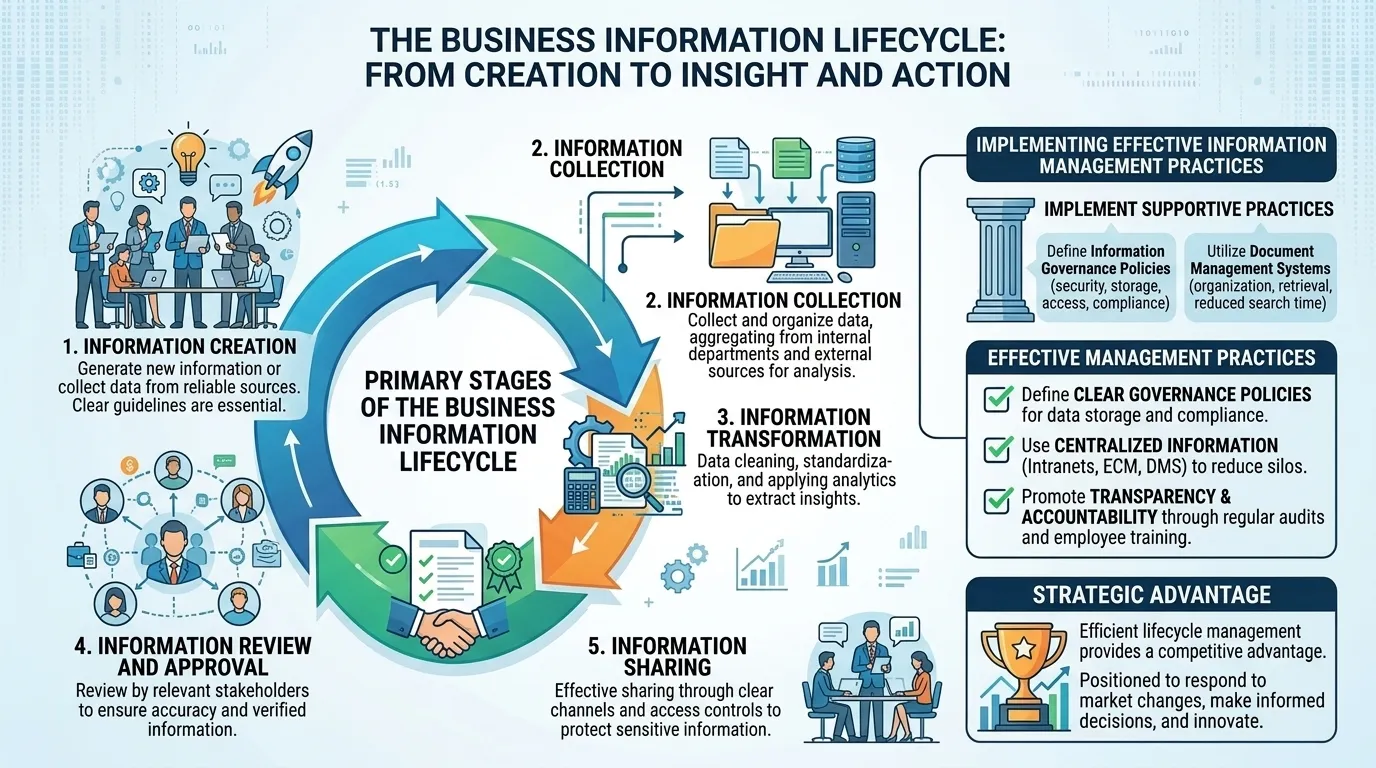
Operationally, understanding how information moves through a business is crucial for maintaining its value. Poor management can lead to delays, misunderstandings, and unnecessary work, even with accurate data. Therefore, businesses must implement processes that ensure clear ownership and organized handoffs of information as it progresses.
Context is paramount in the business information lifecycle. Information without context can be misleading or useless. For example, sales data lacking market trends or seasonal fluctuations context might lead to incorrect performance conclusions. Thus, preserving creation and sharing context is vital for effective use.
Implementing Effective Information Management Practices
To manage business information effectively, organizations should adopt practices that promote clarity, accessibility, and accountability. This includes establishing clear policies on information creation, sharing, and storage, as well as implementing supportive technologies. Utilizing document management systems, for instance, can help organize and retrieve information efficiently, reducing search time.
- Define Information Governance Policies: Clear policies on what information is collected, how it is stored, and who has access are essential. These should also cover data security and compliance with regulations.
- Use Centralized Information Systems: Implementing centralized systems can reduce silos and improve accessibility. Such systems include intranets, document management software, or enterprise content management systems.
- Promote Transparency and Accountability: Ensuring information transparency and accountability for its accuracy and use is critical. This involves regular audits of systems and processes, as well as employee training on information integrity.
Strategically, businesses must recognize that effective management of their information lifecycle is a competitive advantage. Organizations that create, share, and use information efficiently are better positioned to respond to market changes, make informed decisions, and innovate. Investing in supportive processes and technologies is essential for long-term success.
The lifecycle of business information is complex, involving several stages from creation to action. Understanding these stages and implementing effective management practices ensure that information remains accurate, relevant, and useful throughout its lifecycle. By adopting a structured approach, businesses can improve communication, reduce risks associated with poor handling, and make better-informed decisions.
Information Flow Across Departments: A Critical Business Challenge
Effective management of information across different departments is crucial for organizational success. It directly impacts the ability to make informed decisions, maintain operational efficiency, and ensure compliance with regulatory requirements. However, this process is often hindered by information silos, which can lead to duplication of efforts, delays, and misunderstandings. A study published in the Harvard Business Review notes that "information silos can be a major obstacle to effective decision-making, as they limit access to critical information and create barriers to communication between different parts of the organization."
The challenges associated with managing information across departments are multifaceted. Operationally, the lack of standardized processes and protocols for information sharing can result in confusion and errors. For example, a sales department may use a different customer relationship management (CRM) system than the marketing department, leading to inconsistencies in data and difficulties in tracking customer interactions. The absence of clear ownership and accountability for information can also lead to a lack of trust and confidence in the data being shared.
- Information silos: Separate systems, processes, and cultures within different departments create barriers to information sharing and collaboration.
- Lack of standardization: Inconsistent formats, protocols, and standards for information exchange lead to confusion and errors.
- Insufficient training: Employees may not have the necessary skills or knowledge to effectively manage and share information across departments.
A McKinsey & Company study found that companies with effective information management systems have seen significant productivity improvements, with some reporting increases of up to 20%. To achieve such outcomes, organizations must adopt a holistic approach to managing information across departments. This involves establishing clear policies and procedures for information sharing, providing training and support to employees, and implementing technology solutions that facilitate collaboration and data integration.
Effective information management is not just about storing and retrieving data; it's about creating an environment where information can flow freely and be used to drive business decisions. - Gartner
Strategically, the ability to manage information effectively across departments is critical for driving business outcomes such as improved customer satisfaction, increased revenue, and enhanced competitiveness. As Forrester Research notes, "companies that have mastered the art of information management are better equipped to respond to changing market conditions, innovate, and stay ahead of the competition." To achieve this level of mastery, organizations must prioritize the development of a robust information management framework that addresses the challenges associated with information silos, lack of standardization, and insufficient training.
Ineffective information management across departments also poses a secondary risk factor: the potential for errors, omissions, or misinterpretations of critical data. This can have serious consequences, including financial losses, reputational damage, and regulatory non-compliance. To mitigate these risks, organizations must implement robust controls and governance structures that ensure the accuracy, completeness, and integrity of information being shared across departments.
A framework for managing information across departments should include:
- Clear policies and procedures for information sharing
- Standardized formats and protocols for information exchange
- Training and support for employees
- Technology solutions that facilitate collaboration and data integration
- Robust controls and governance structures to ensure data accuracy and integrity
By adopting such a framework, organizations can create an environment where information flows freely and is used to drive business decisions. As the business landscape evolves, the ability to manage information effectively across departments will become increasingly critical for achieving success.
A Framework for Improving Information Flow in Your Organization
Effective information management is critical to an organization's success, directly impacting business decisions and overall performance. A well-designed framework can help businesses overcome common challenges like information silos, duplicate data, and outdated information. This section explores a comprehensive framework for improving information flow and making better-informed decisions.
Operationally, information flow can be broken down into several key stages: creation, collection, transformation, review, approval, sharing, storage, and access. Each stage presents unique challenges and opportunities for improvement. For instance, during creation, organizations must ensure that information is accurate, relevant, and properly contextualized. The following table provides a detailed overview of each stage and its associated challenges and opportunities:
| Stage | Challenges | Opportunities |
|---|---|---|
| Creation | Ensuring accuracy and relevance, providing proper context | Implementing data validation checks, using standardized templates |
| Collection | Avoiding duplicate data, ensuring completeness | Using automated data collection tools, implementing data deduplication processes |
| Transformation | Maintaining data integrity during transformation, ensuring consistency | Using standardized data transformation protocols, implementing data quality checks |
| Review | Ensuring timely and accurate review, preventing information bottlenecks | Implementing automated review workflows, using collaborative review tools |
| Approval | Ensuring proper authorization and authentication, preventing unauthorized access | Implementing role-based access control, using digital signatures |
| Sharing | Ensuring secure and timely sharing, preventing information leaks | Using encrypted communication channels, implementing access controls |
| Storage | Ensuring data security and integrity during storage, preventing data loss | Using redundant storage systems, implementing backup and recovery processes |
| Access | Ensuring timely and secure access, preventing unauthorized access | Implementing role-based access control, using single sign-on authentication |
Poor information flow can lead to decision-making delays or errors due to a lack of trust in the data. To mitigate this risk, organizations must prioritize information management and implement a framework that ensures accurate, timely, and secure information flow.
Improving information flow requires a comprehensive approach that addresses both technical and organizational aspects. This framework provides a structured approach:
- Define information management policies and procedures
- Implement standardized data collection and transformation protocols
- Use automated workflows and collaborative tools to facilitate review and approval
- Ensure secure and timely sharing of information using encrypted communication channels
- Implement role-based access control and single sign-on authentication for secure access
- Monitor and evaluate information flow regularly to identify areas for improvement
Standardized data collection and transformation protocols are crucial for ensuring consistency and accuracy in data. Automated workflows and collaborative tools can facilitate review and approval processes, reducing the risk of information bottlenecks and delays.
Proper context is essential for effective information flow. Without it, information can be misinterpreted or misunderstood, leading to poor decision-making. Organizations must ensure that information is properly documented and maintained throughout its lifecycle, including accurate metadata, standardized naming conventions, and clear descriptions.
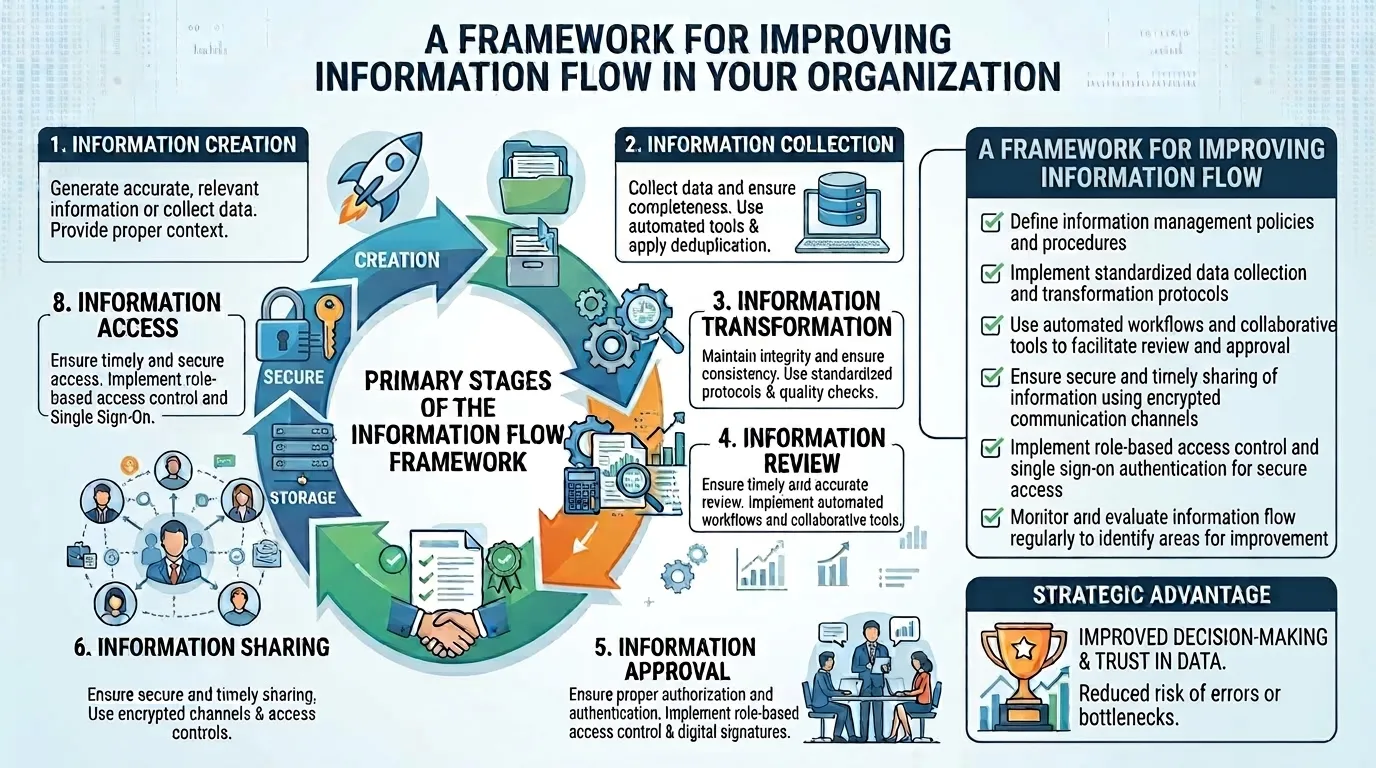
Improving information flow is critical to an organization's success. By implementing a comprehensive framework, organizations can ensure accurate, timely, and secure information flow, leading to better-informed business decisions, improved trust in data, and reduced risk of decision-making delays or errors.
Practical Steps for Implementing Effective Information Management
Effective information management is crucial for businesses to maintain accuracy, communicate effectively, and make informed decisions. The usefulness of information depends on its context, accuracy, source, and purpose. To implement better information management practices, businesses must first identify areas that require improvement by analyzing the current information flow, identifying bottlenecks, and determining strategies for enhancing information accuracy and decision-making.
Information management involves several critical components: creation, collection, transformation, review, approval, sharing, storage, access, context, accuracy, ownership, and handoffs. Each component plays a vital role in ensuring that information is accurate, reliable, and accessible to those who need it. By understanding how information moves through a business, organizations can establish clear ownership, maintain organized handoffs, and reduce the risk of delays, duplication, misunderstandings, and unnecessary work.
Poorly managed information can lead to the formation of information silos within an organization. When different departments or teams have separate systems for managing information, it can result in duplicate information, outdated information, and a lack of visibility across the organization. To mitigate this risk, businesses must implement strategies that promote information sharing, collaboration, and transparency through centralized information management systems, clear communication protocols, and regular training programs.
- Information Accuracy: Implementing quality control processes to ensure the accuracy and reliability of information is critical. This includes verifying sources, validating data, and conducting audits to identify and correct errors.
- Decision-Making Information: Providing timely and relevant information to support decision-making is essential. This involves identifying key performance indicators (KPIs) that drive business decisions and ensuring that necessary data is available and accessible to those who need it.
Achieving effective information management requires a structured approach with clear policies, procedures, and guidelines. Businesses should establish an information management framework that outlines the key principles, roles, and responsibilities for managing information across the organization. The framework should define processes for creating, collecting, transforming, reviewing, approving, sharing, storing, accessing, and maintaining information.
Implementing effective information management involves technical, operational, and cultural changes. This includes investing in information management systems, training employees on new procedures and protocols, and promoting a culture of transparency and collaboration. By taking a holistic approach to information management, businesses can improve the accuracy, reliability, and accessibility of information, leading to better decision-making and improved business outcomes.
The following checklist provides a practical toolkit for implementing effective information management practices:
- Conduct an information audit to identify areas for improvement
- Establish clear policies and procedures for managing information
- Implement quality control processes to ensure information accuracy
- Provide training programs for employees on new procedures and protocols
- Promote a culture of transparency and collaboration across the organization
- Regularly review and update information management systems and processes
By following these practical steps and implementing effective information management practices, businesses can improve how they create, collect, transform, review, approve, share, store, access, and maintain information. This will enable them to make better-informed decisions, reduce the risk of errors and delays, and achieve improved business outcomes.
Frequently Asked Questions
How does information flow between departments?
Information flows between departments through business processes, communication, shared information, reviews, approvals, and operational handoffs. Standardized processes and clear ownership can reduce duplication, delays, misunderstandings, and information silos.
How do information silos affect business operations?
Information silos can prevent departments from accessing information held elsewhere in the organization. This can contribute to duplicate information, outdated information, inconsistent data, delays, and misunderstandings.
How does information move through a business?
Business information typically moves through stages that include creation, collection, transformation, review, approval, sharing, storage, and access. The stages may overlap, but each affects the accuracy, context, accessibility, and usefulness of the information.
Why does context matter when sharing business information?
Context helps people understand where information came from, what it represents, why it was created, and how it should be used. Without sufficient context, accurate information can still be misunderstood or lead to incorrect conclusions.
What happens when business information is poorly managed?
Poorly managed information can contribute to delays, errors, duplication, misunderstandings, unnecessary work, and reduced confidence in the information used for business decisions. These problems can also make it harder for departments to coordinate their activities.
How can a business improve its information flow?
A business can improve information flow by defining information management policies, standardizing how information is collected and transformed, establishing clear ownership, organizing information handoffs, improving review and approval processes, and regularly evaluating how information moves through the organization.
How does organized information support better decision-making?
Organized information makes it easier for decision makers to find relevant information, understand its context and accuracy, and use it at the appropriate point in a business process. This reduces the risk of decisions being delayed or based on incomplete or misunderstood information.
How can businesses prevent information from becoming outdated or duplicated?
Businesses can reduce outdated and duplicate information by establishing clear ownership, standardizing information processes, improving visibility across departments, and regularly reviewing information and the processes used to maintain it.
How can a business identify problems in its information flow?
A business can conduct an information audit to identify where information is created, how it moves between people and departments, where bottlenecks occur, and where information becomes duplicated, outdated, inaccessible, or separated from its context.
What should a business include in an information management framework?
An effective framework should address information creation, collection, transformation, review, approval, sharing, storage, access, ownership, accuracy, context, and accountability. It should also establish policies and procedures for how information is managed across the organization.
What are the stages of the business information lifecycle?
The business information lifecycle includes creation, collection, transformation, review, approval, sharing, storage, and access. Managing each stage helps preserve the accuracy, relevance, context, and usefulness of information.
Why is information flow important in a business?
Effective information flow helps ensure that accurate and relevant information reaches the people who need it when they need it. This supports communication, operational efficiency, and better-informed business decisions.