

What Is the Best Way to Organize Documents?
Best practices for organizing business documents to improve governance, document management, collaboration, and decision-making.
published:

- 28
- 833
- 94
Effective document organization is the cornerstone of trustworthy business communication, as it enables stakeholders to locate and understand critical information with ease. The concept of information architecture plays a pivotal role in this context, referring to the systematic design and organization of information to facilitate efficient access and retrieval. When properly implemented, information architecture helps to mitigate the risks associated with poor document management, such as version control issues, data duplication, and decreased productivity.
The importance of document organization cannot be overstated, as it has a direct impact on an organization's ability to make informed decisions. The inability to locate critical information in a timely manner can lead to delayed decision-making, resulting in lost opportunities and compromised competitiveness. This underscores the need for businesses to prioritize document organization as a key component of their overall knowledge management strategy.
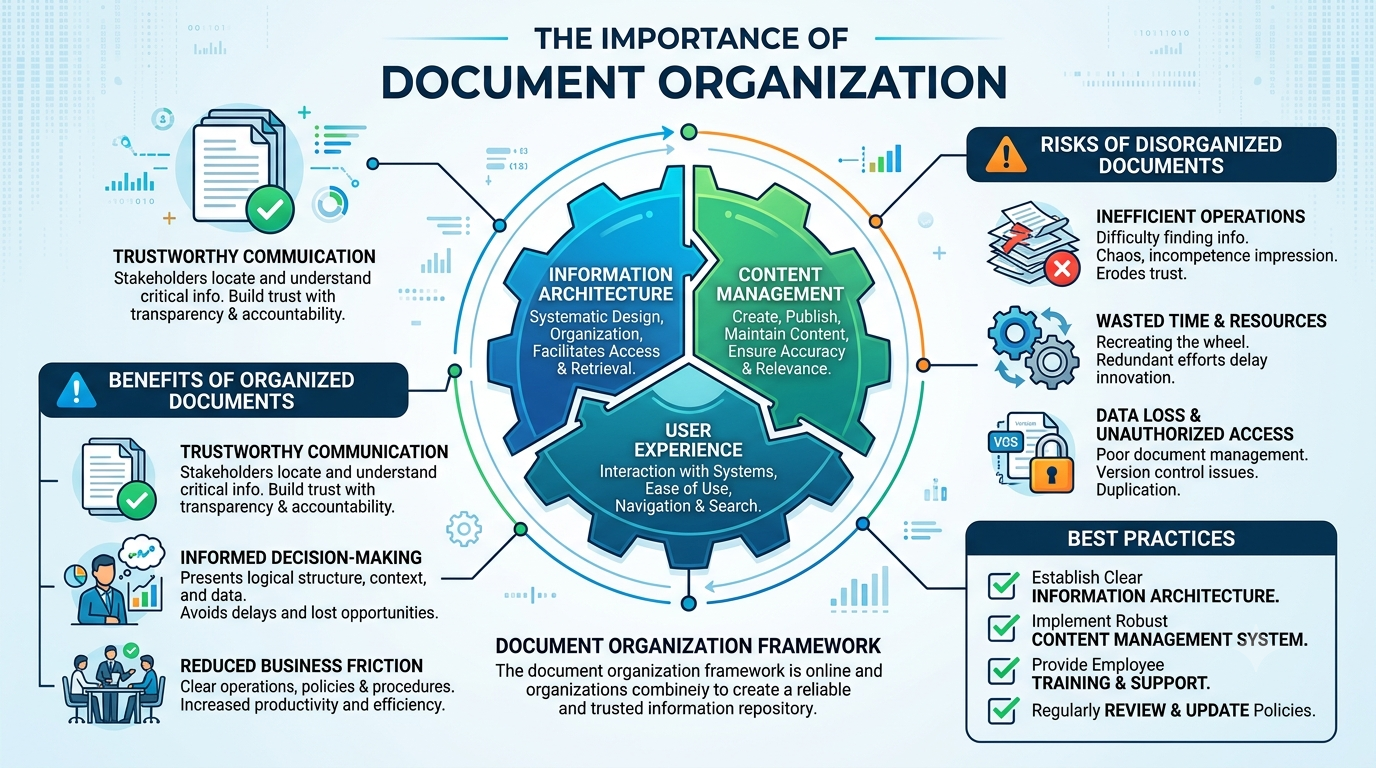
From an operational perspective, well-organized documents help to reduce business friction by providing a clear understanding of the organization's operations, policies, and procedures. This, in turn, enables employees to work more efficiently, as they can quickly locate the information they need to perform their tasks. Moreover, a structured approach to document management helps to ensure that critical information is preserved and protected, minimizing the risk of data loss or unauthorized access.
The relationship between document organization and trust is multifaceted. On one hand, a well-organized document repository demonstrates an organization's commitment to transparency and accountability, as stakeholders can easily access and review relevant information. On the other hand, disorganized documents can create an impression of chaos and incompetence, eroding trust among customers, partners, and employees alike. As knowledge management expert,
Thomas Davenport has argued that organizations build confidence in their information by understanding what information assets they possess, who can access them, and how those assets support decision-making
The secondary risk factor associated with poor document organization is the potential for duplicated effort. When employees are unable to locate existing documents or information, they may recreate the wheel, resulting in wasted time and resources. This can be particularly problematic in industries where research and development are critical, as redundant efforts can delay innovation and hinder competitiveness. To mitigate this risk, organizations should implement a robust document management system that facilitates easy searching, categorization, and retrieval of information.
From a decision-making perspective, clear and organized documents provide context, which is essential for informed decision-making. By presenting information in a logical and structured manner, organizations can help stakeholders understand the underlying factors driving business outcomes. This, in turn, enables more effective decision-making, as stakeholders can evaluate options and make choices based on a comprehensive understanding of the relevant data. The following framework highlights the key elements of document organization that contribute to informed decision-making:
| Element | Description |
|---|---|
| Information Architecture | The systematic design and organization of information to facilitate efficient access and retrieval. |
| Content Management | The process of creating, publishing, and maintaining content in a way that ensures accuracy, relevance, and accessibility. |
| User Experience | The overall experience of interacting with an organization's documents and information systems, including ease of use, navigation, and search functionality. |
To ensure that document organization is optimized for trust, clarity, and decision-making, organizations should prioritize the following best practices:
- Establish a clear information architecture that reflects the organization's operations and priorities
- Implement a robust content management system that facilitates easy searching, categorization, and retrieval of information
- Provide training and support to ensure that employees understand how to create, manage, and maintain organized documents
- Regularly review and update document management policies and procedures to ensure they remain relevant and effective
The interplay between document organization, trust, and decision-making is complex and multifaceted. By prioritizing information architecture, content management, and user experience, organizations can create an environment that fosters transparency, accountability, and informed decision-making. As the volume and complexity of business data continue to grow, the importance of effective document organization will only continue to increase, making it essential for organizations to invest in robust document management systems and processes that support trust, clarity, and competitiveness.
From Chaos to Clarity: Practical Steps to Organize Your Business Documents
The ability of an organization to effectively manage its documents is a critical component of trust, clarity, and decision-making. When documents are disorganized, it can lead to wasted time, duplicated effort, and a general sense of chaos. However, by implementing practical steps towards document organization, businesses can significantly reduce these risks and improve overall productivity.
From an operational perspective, the first step in organizing business documents is to establish a clear understanding of what needs to be organized. This involves categorizing documents into types, such as financial reports, contracts, and meeting minutes, and then determining the level of access required for each category. A well-structured document management system should also take into account the different departments within an organization and ensure that each department has access to the necessary documents.
- Conduct a Document Inventory: The initial step in organizing business documents is to conduct a thorough inventory of all existing documents. This involves gathering all physical and digital documents, including emails, contracts, reports, and meeting notes, and categorizing them based on their type, importance, and required access level.
- Implement a Document Management System: Once the document inventory is complete, the next step is to implement a document management system that can effectively store, manage, and retrieve documents. This system should be designed with scalability in mind, allowing for easy addition of new documents and categories as the organization grows.
- Establish Access Controls: To ensure that sensitive information is protected, it's crucial to establish access controls within the document management system. This involves setting up user roles and permissions, ensuring that only authorized personnel can access specific documents or categories of documents.
From a technical standpoint, the use of metadata and tagging can significantly enhance document organization. By assigning relevant keywords and tags to each document, organizations can improve search functionality, making it easier for employees to locate specific documents. Additionally, the use of version control ensures that all changes made to documents are tracked, reducing the risk of confusion or data loss.
The secondary risk factor associated with disorganized documents is the potential for critical information to be lost or misplaced. When documents are scattered across multiple systems or stored without context, it can lead to significant delays in decision-making processes. By implementing a centralized document management system, organizations can mitigate this risk and ensure that all relevant information is readily available.
Practical Examples of Effective Document Organization
A real-world example of effective document organization can be seen in the implementation of a cloud-based document management system by a mid-sized financial services firm. Prior to implementing the system, employees spent an average of two hours per day searching for documents, resulting in significant productivity losses. However, after implementing the new system, search times were reduced by 75%, and employee productivity increased substantially.
| Document Type | Access Level | Retention Period |
|---|---|---|
| Financial Reports | Restricted | 7 years |
| Contracts | Confidential | 10 years |
The decision to implement a document management system should be based on a thorough analysis of the organization's specific needs and requirements. By considering factors such as document volume, access levels, and retention periods, organizations can design a system that effectively meets their needs and improves overall productivity.
Avoiding Common Pitfalls: Mistakes to Watch Out for in Document Organization
Effective document organization is crucial for businesses to establish trust, facilitate clear communication, and ensure timely decision-making. However, numerous organizations fall prey to common pitfalls that hinder their ability to achieve these objectives. A primary mistake is the lack of a structured document lifecycle, which encompasses the creation, storage, retrieval, and disposal of documents. Without such a framework, metadata becomes inconsistent, making it challenging for employees to locate critical information, thus wasting valuable time and resources.
- Document Metadata
- Metadata plays a vital role in document organization as it provides context about the document's content, authorship, and relevance. Inadequate or inconsistent metadata can render even the most robust document management system ineffective, as users struggle to find documents due to poor search functionality.
- Document Lifecycle Management
- A well-defined document lifecycle ensures that documents are properly created, reviewed, approved, stored, and eventually disposed of. This process helps in maintaining the integrity and accessibility of documents, thereby supporting business operations and reducing legal risks.
From an operational perspective, the failure to implement a standardized document organization system can lead to significant inefficiencies. Employees spend a considerable amount of time searching for information, only to find that it is either inaccessible or outdated. This not only affects productivity but also erodes confidence among team members and stakeholders, as they begin to question the reliability of the information available to them.
The secondary risk factor associated with poor document organization is the duplication of work. When teams cannot find existing documents or information, they often end up recreating it, which leads to a waste of resources and an increased potential for errors. By organizing documents effectively, businesses can avoid such pitfalls, ensuring that all information is not only accessible but also up-to-date and relevant.
Given these considerations, it is clear that effective document organization is not merely a matter of storage or encryption but rather a comprehensive approach that encompasses trust, clarity, communication, understanding, decision-making, and context. By avoiding common pitfalls such as inadequate metadata management, poor version control, and the lack of a structured document lifecycle, organizations can significantly enhance their operational efficiency, reduce costs, and improve decision-making capabilities.
Sustaining Excellence: Tools and Best Practices for Long-Term Document Organization Success
Effective document organization is a critical component of business operations, influencing trust, communication, and decision-making processes. As organizations grow and evolve, maintaining a well-structured document management system becomes increasingly complex. The key to sustaining excellence in document organization lies in implementing robust tools and best practices that foster collaboration, ensure consistency, and promote long-term success.
From an operational perspective, the secondary risk factor associated with inadequate document organization is the duplication of efforts and version control issues. When employees spend excessive time searching for documents or maintaining multiple versions of the same file, productivity suffers, and business friction increases. To mitigate these risks, organizations must adopt a structured approach to document management, incorporating tools such as centralized repositories, automated workflows, and access controls.
Clear information builds confidence, and better communication leads to better decisions. By prioritizing document organization, businesses can create an environment that fosters trust, collaboration, and informed decision-making.
A well-designed document management system should be built around the principles of simplicity, accessibility, and scalability. This can be achieved by implementing a framework that categorizes documents based on their purpose, audience, and retention requirements. For instance, a simple yet effective framework might include the following categories:
- Corporate documents: policies, procedures, and governance materials
- Operational documents: process guides, training manuals, and standard operating procedures
- Project documents: project plans, meeting minutes, and progress reports
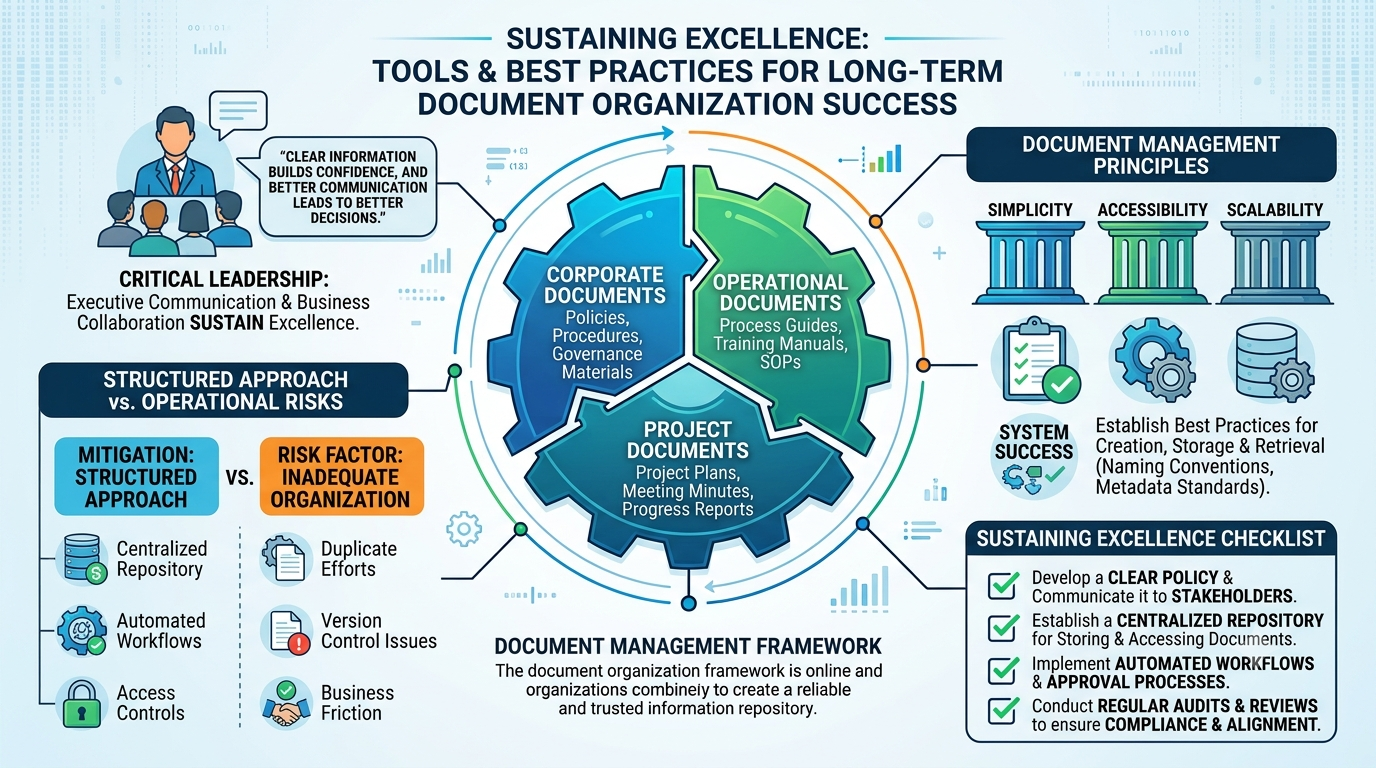
To ensure the long-term success of a document management system, organizations must also establish best practices for document creation, storage, and retrieval. This includes implementing naming conventions, metadata standards, and access controls to prevent unauthorized modifications or deletions. Additionally, regular audits and reviews should be conducted to identify areas for improvement and ensure that the document management system remains aligned with business objectives.
The following checklist provides a starting point for organizations seeking to establish effective document management best practices:
- Develop a clear document management policy and communicate it to all stakeholders
- Establish a centralized repository for storing and accessing documents
- Implement automated workflows and approval processes for document creation and modification
- Conduct regular audits and reviews to ensure compliance with document management policies
By prioritizing document organization and implementing robust tools and best practices, businesses can create an environment that fosters trust, collaboration, and informed decision-making. As the volume and complexity of documents continue to grow, it is essential for organizations to adopt a proactive approach to document management, ensuring that their systems remain scalable, accessible, and aligned with business objectives.
The relationship between business collaboration and executive communication is critical in sustaining excellence in document organization. When executives communicate effectively, they create an environment that fosters trust, transparency, and accountability. This, in turn, enables employees to work collaboratively, sharing knowledge and expertise to drive business success. By investing in document management systems and processes that support these principles, organizations can create a culture of excellence that permeates every aspect of their operations.
Frequently Asked Questions
How can businesses make documents easier to find?
Businesses can improve document retrieval by using standardized naming conventions, applying consistent metadata, organizing files within a well-defined taxonomy, and storing documents in a centralized repository. These practices reduce search time and improve information accessibility.
How should a document organization system grow as a business expands?
A scalable document organization system uses standardized structures, modular architecture, centralized repositories, and regular maintenance so it can accommodate increasing numbers of documents, users, and business processes without becoming difficult to manage.
What mistakes make document organization difficult to maintain?
Common problems include inconsistent file names, missing metadata, multiple storage locations, unclear folder structures, weak access controls, and a lack of documented governance policies. Over time these issues make documents harder to locate, share, and secure.
Should document organization include security and access controls?
Yes. Document organization should include role-based permissions, secure authentication, encryption where appropriate, and clearly defined access policies. Organizing documents without controlling who can view or modify them creates unnecessary security and compliance risks.
What are the most important elements of an effective document organization system?
An effective document organization system combines a consistent taxonomy, standardized file naming conventions, meaningful metadata, a logical folder structure, centralized storage, and appropriate access controls. Together, these elements make documents easier to locate, manage, and secure
How do naming conventions and metadata work together?
Naming conventions provide consistency that people can easily recognize, while metadata adds searchable information such as document type, author, creation date, and keywords. Using both together improves search accuracy and simplifies document management.