

What Are the Hidden Costs of Disorganized Documents?
Disorganized business documents create hidden costs through wasted search time, duplicate work, decision-making delays, and operational risk. This guide explains how document organization and effective document management can reduce these costs and improve business efficiency, reliability, and decision-making.
published:

- 28
- 833
- 11
Assessing the Operational Consequences of Disorganized Business Documents
Disorganized business documents have far-reaching consequences, affecting various aspects of an organization's operations and decision-making processes. The core issue is the inability to efficiently locate, understand, validate, and utilize critical business information. This inefficiency stems from a lack of consistent structure in document organization, leading to confusion, delays, and unnecessary operational risks. To understand the full extent of these consequences, it's essential to examine the impact on business processes, decision-making, and compliance management.
Operationally, disorganized documents create an environment where information is not readily accessible or reliable. This leads to wasted employee time, as staff members spend significant amounts of time searching for the correct version of a document or verifying the accuracy of the information contained within. Without a well-structured document management system, duplicated efforts occur, as employees may unknowingly recreate documents that already exist, further exacerbating the problem of information sprawl. The consequences of disorganized document management are outlined in Table 1.
| Consequence | Description |
|---|---|
| Increased Search Time | Employees spend more time searching for documents, decreasing productivity. |
| Duplicate Work | Without access to current or accurate documents, employees may recreate existing work. |
| Decision-Making Delays | Lack of timely access to necessary information hinders decision-making processes. |
| Operational Risks | Inaccurate or outdated information can lead to operational mistakes and potential legal issues. |
Disorganized documents significantly affect an organization's decision-making process. When critical business information is disorganized, executives and decision-makers struggle to access the data they need in a timely manner. This delay can result in missed opportunities, poor strategic decisions, and an inability to respond effectively to market changes or customer needs. Effective decision-making relies on the availability of accurate, up-to-date information, which disorganized documents compromise.
Compliance management is another area where disorganized documents pose a risk. Regulatory requirements demand that businesses maintain accurate and accessible records. Disorganization can lead to non-compliance, as essential documents may be missing, outdated, or inaccessible when needed for audits or legal proceedings. The consequences of non-compliance can be severe, including fines, legal action, and damage to the company's reputation. Implementing a robust document management system is crucial for ensuring compliance with regulatory standards.
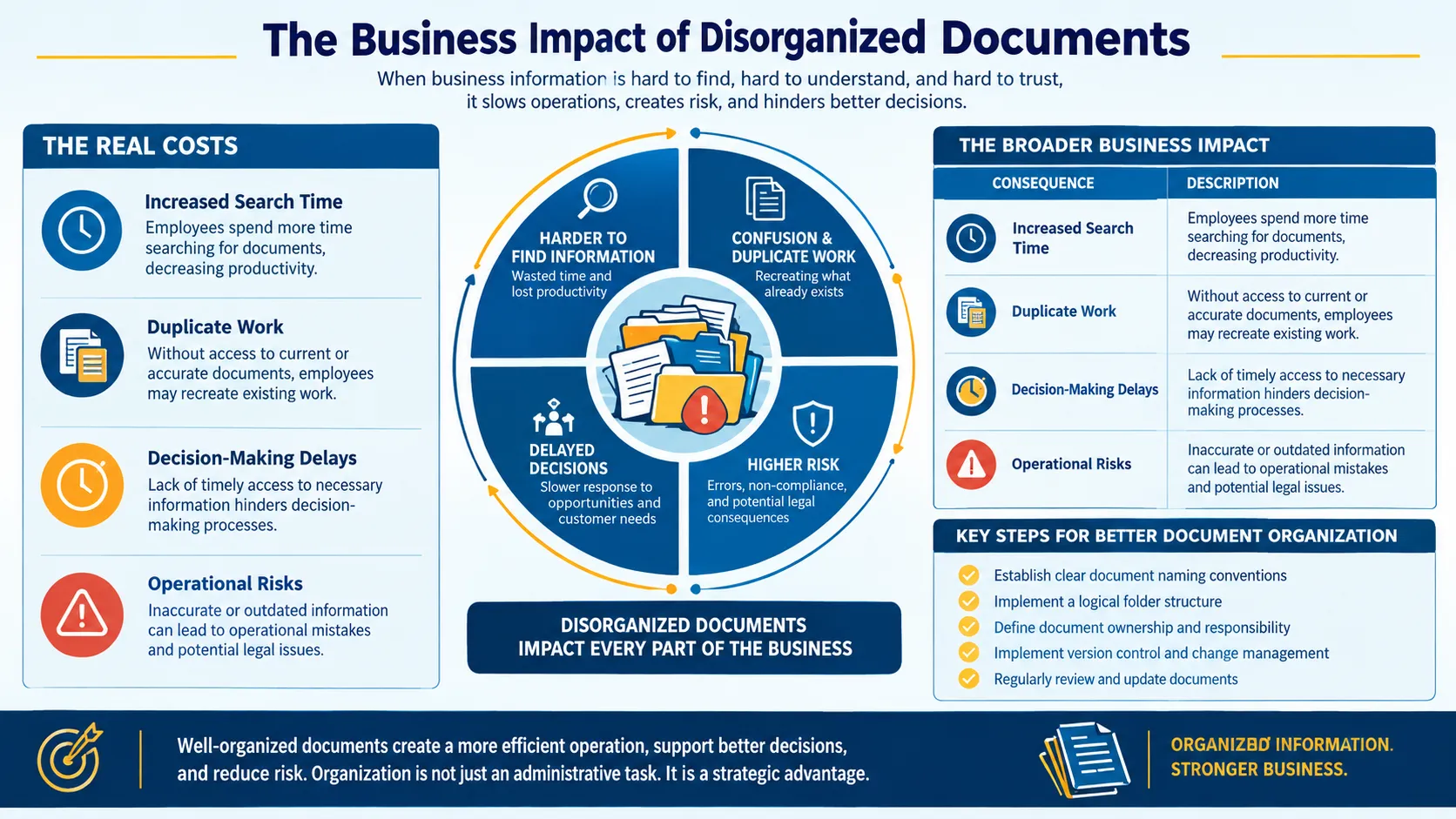
To mitigate these risks and improve operational efficiency, businesses must adopt a structured approach to document organization. This involves implementing clear document naming conventions, establishing a logical folder structure, and defining document ownership and version control processes. By doing so, companies can ensure that critical business information is predictable, understandable, and maintainable over time, supporting reliable collaboration, operations, and decision-making. Key steps in achieving effective document organization include:
- Establishing clear document naming conventions
- Implementing a logical folder structure
- Defining document ownership and responsibility
- Implementing version control and change management
- Regularly reviewing and updating documents
Implementing a well-structured document management system is a critical component of operational strategy, directly influencing an organization's ability to execute its business model efficiently, respond to challenges, and capitalize on opportunities. By addressing document disorganization, executives can foster a more agile, responsive, and compliant organization, positioning the business for long-term success and sustainability in a competitive and regulated environment.
Learn More About How Document Disorganization Affects Business Productivity
Principles for Effective Business Document Organization
Effective business document organization relies on fundamental principles that reduce the costs associated with disorganized documents. These principles include document naming conventions, document structure, and information governance, which work together to make documents easily accessible, understandable, and maintainable over time. This facilitates collaboration, operations, and decision-making within an organization.
Establishing robust document naming conventions is crucial. This involves creating a standardized system for naming documents that includes metadata such as document type, date, version number, and author. This ensures documents are easily identifiable and retrievable, reducing search time and minimizing the risk of using outdated documents. Key considerations for developing effective document naming conventions include:
- Uniqueness: Each document should have a unique name that distinguishes it from others.
- Consistency: A consistent naming format should be used across all documents for easy recognition and retrieval.
- Relevance: The document name should reflect the content and purpose of the document.
Document structure is another vital principle. A well-structured document is logically organized, easy to navigate, and provides clear and concise information. This can be achieved with a standardized template that includes a title page, table of contents, introduction, body, and conclusion. Headings, subheadings, and bullet points can also help break up complex information and make it more readable. The key components of a well-structured document are:
- Title Page
- A page with the document title, author, date, and version number.
- Table of Contents
- A list of the document's contents, including headings and subheadings.
- Introduction
- A brief overview of the document's purpose and scope.
- Body
- The main content, which should be logically organized and easy to follow.
- Conclusion
- A summary of the document's key findings and recommendations.
Information governance is the third critical principle. It refers to the policies, procedures, and standards for managing an organization's information assets, including documents, emails, databases, and websites. Effective information governance ensures information is accurate, reliable, and accessible, while protecting sensitive information from unauthorized access or disclosure.
The implementation of these principles can significantly impact an organization's efficiency and effectiveness. By establishing clear document naming conventions, structuring documents logically, and governing information assets effectively, organizations can reduce search time, minimize errors, and improve collaboration and decision-making. The key steps involved are:
- Develop and implement a standardized document naming convention.
- Establish a consistent document structure with key elements like a title page and table of contents.
- Develop and implement an information governance policy to ensure the accuracy and accessibility of organizational information.
- Provide training and support on the principles of effective document organization and information governance.
- Regularly review and update documents and policies to ensure they remain relevant and effective.
Disorganized documents can lead to information silos, where critical information is not shared or is inaccessible. This can cause duplicated effort, inconsistent decisions, and delayed approvals, affecting the organization's ability to operate efficiently. Applying the principles of effective document organization can mitigate this risk and ensure information is shared and accessible when needed.
Implement a Document Organization Strategy
A well-structured document organization system is essential for minimizing the risks associated with disorganized documents, such as wasted employee time, duplicate work, and delayed approvals. This system enables employees to easily locate, understand, validate, and use important business information, leading to better decision-making and improved collaboration. From an operational perspective, a document organization strategy should reflect how the business actually uses information, including ownership, purpose, frequency of use, and the stages information passes through.
Disorganized documents can lead to information silos, where critical business information is scattered across multiple locations, making it difficult to access and maintain. To mitigate this risk, businesses must establish clear document ownership and define a document workflow that ensures information is properly created, reviewed, approved, and stored. Document ownership assigns responsibility for maintaining and updating documents, ensuring that information remains accurate and up-to-date. A well-defined document workflow provides a clear understanding of the processes and procedures involved in managing documents, from creation to disposal.
To implement a document organization strategy, businesses can start by conducting a document audit to identify areas where documents are disorganized or redundant. This involves analyzing the current document landscape, including the types of documents, their locations, and the processes involved in managing them. By understanding the current state of document organization, businesses can identify opportunities for improvement and develop a tailored strategy to address these gaps. The following steps can help:
- Define document ownership and assign responsibility for maintaining and updating documents
- Establish a document workflow that ensures information is properly created, reviewed, approved, and stored
- Develop a consistent naming convention and folder structure for documents
- Use metadata to enhance document discoverability
- Conduct regular document audits to ensure information remains accurate and up-to-date
Capturing institutional knowledge is also critical. Institutional knowledge refers to the collective knowledge and expertise of an organization, often embedded in documents, policies, and procedures. By capturing and preserving this knowledge, businesses can reduce the risk of knowledge loss due to employee turnover or retirement, and ensure that critical information is retained and passed on to future generations. To capture institutional knowledge, businesses can:
- Identify critical documents and information that contain institutional knowledge
- Develop a process for capturing and preserving this knowledge
- Assign responsibility for maintaining and updating institutional knowledge
- Establish a knowledge management system to store and retrieve institutional knowledge
By implementing a document organization strategy that addresses document ownership, workflow, and institutional knowledge, businesses can create a more reliable foundation for collaboration, operations, and decision-making. This can lead to improved productivity, reduced risk, and enhanced competitiveness. As businesses continue to generate and rely on increasingly large volumes of documents, the need for effective document organization will only continue to grow, making it essential for organizations to prioritize this critical aspect of information management.
Maintaining and Scaling Document Organization Over Time
As businesses grow, the complexity of their document landscape increases, posing significant challenges to maintaining and scaling document organization. Disorganized documents can lead to wasted employee time, duplicate work, and delayed approvals due to information silos, document sprawl, and outdated documents. Effective document maintenance and retention strategies are crucial to mitigate these risks and ensure that important business information remains predictable, understandable, and maintainable.
Document maintenance involves regular reviews and updates of existing documents to ensure they remain relevant and accurate. A systematic approach is necessary, including the implementation of document naming conventions, folder structures, and document version control. This enables employees to quickly locate and understand the current version of a document, reducing errors and inconsistencies. Key aspects of document maintenance include:
- Regular document reviews to ensure they remain up-to-date and relevant
- Clear approval workflows to authorize and validate documents
- Proper document handoffs between teams and departments to maintain continuity
Document retention is critical, as it directly impacts an organization's ability to maintain institutional knowledge and comply with regulatory requirements. A well-designed document retention strategy should consider the business's information lifecycle, including creation, storage, and disposal of documents. This strategy should align with the organization's overall goals and objectives, ensuring documents are retained for the appropriate amount of time and in a manner that supports business operations.
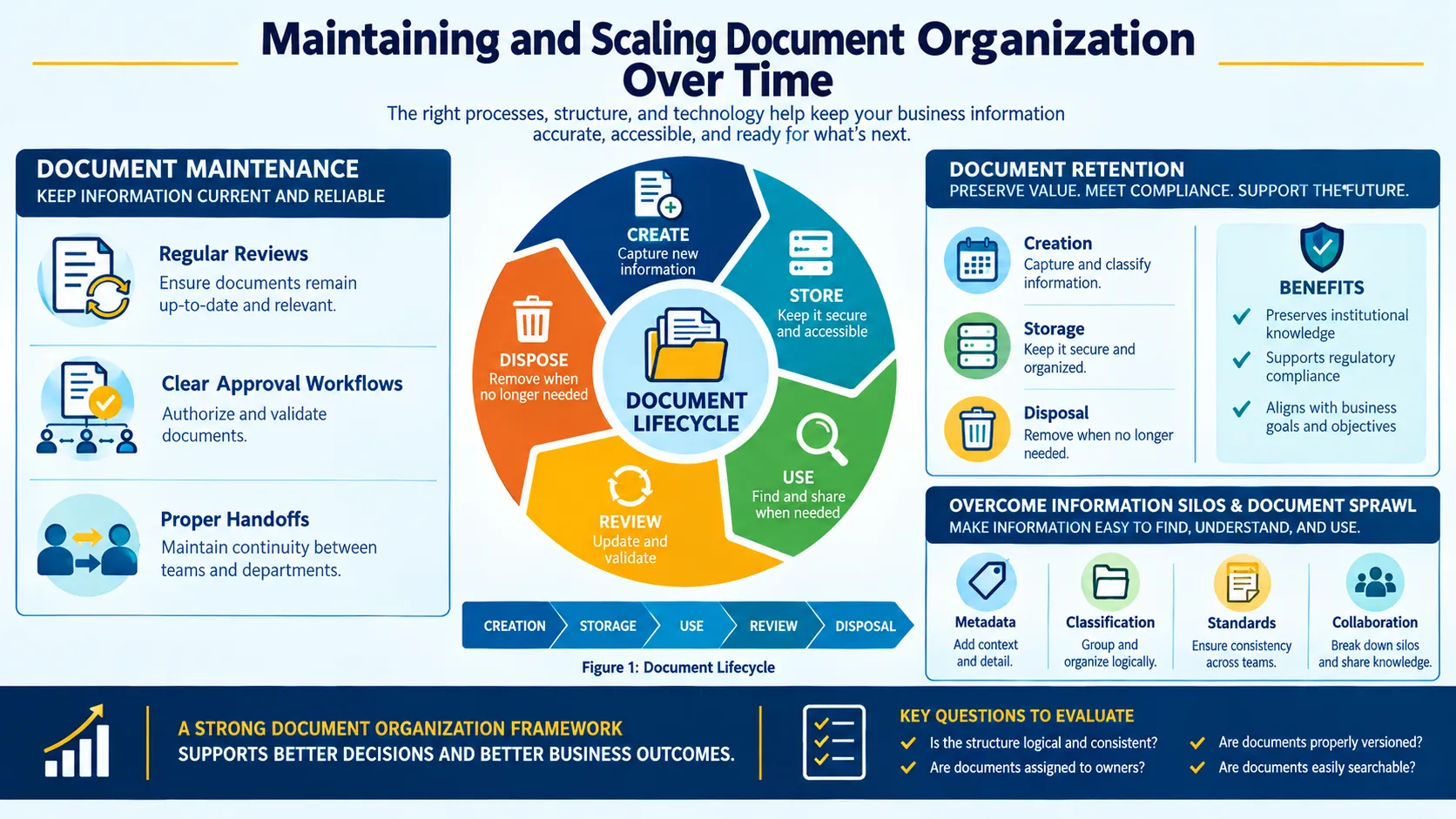
As businesses scale, the risk of information silos and document sprawl increases. Implementing strategies that promote document accessibility and searchability is essential. This can be achieved through the use of document metadata, classification, and standards, enabling employees to quickly locate and understand relevant documents. A document management system that supports collaboration and knowledge sharing can help break down information silos and promote a culture of transparency and openness.
Document organization is an ongoing process that requires continuous monitoring and improvement. By implementing effective document maintenance and retention strategies, businesses can ensure their documents remain organized, accessible, and maintainable, supporting better decision-making and improved business outcomes.
A document organization framework should reflect a business's unique needs and goals, taking into account its structure, processes, and culture. This ensures documents are organized in a way that supports business operations and decision-making. To evaluate the effectiveness of a document organization framework, consider the following:
- Is the document structure logical and consistent?
- Are documents properly assigned to owners and stakeholders?
- Are documents properly versioned and updated?
- Are documents easily searchable and accessible?
Maintaining and scaling document organization over time requires a systematic and strategic approach. By implementing effective document maintenance and retention strategies, promoting document accessibility and searchability, and creating a document organization framework that supports business operations, organizations can ensure their documents remain organized, accessible, and maintainable. This, in turn, supports better decision-making and improved business outcomes. The next step is to evaluate the current state of document organization and identify areas for improvement.
Frequently Asked Questions
How does document organization help preserve institutional knowledge?
Organized documents make important knowledge easier to identify, maintain, retrieve, and transfer when employees change roles or leave the organization. Assigning ownership and maintaining current documents helps prevent critical knowledge from becoming isolated or lost.
What document organization practices reduce search time?
Consistent document naming conventions, logical folder structures, meaningful metadata, document classification, and reliable version control make documents easier to locate and identify. The objective is to make the location and purpose of important information predictable.
How can businesses reduce the cost of disorganized documents?
Businesses can reduce these costs by establishing consistent naming conventions, logical folder structures, document ownership, version control, retention policies, and regular document reviews. These practices make business information easier to locate, understand, validate, and maintain.
How does document disorganization create operational risk?
Using outdated, inaccurate, missing, or inaccessible documents can lead to operational mistakes and make it harder to maintain reliable business processes. The risk increases when employees cannot determine which information is current or authoritative.
How do disorganized documents affect employee productivity?
Employees spend more time searching for documents, determining which version is current, and verifying whether information is accurate. This reduces the time available for productive business work and can lead to repeated requests and duplicate work.
How do disorganized documents delay business decisions?
When decision-makers cannot quickly locate accurate and current information, they may have to wait for documents, verify information manually, or work with incomplete information. This can delay approvals, slow responses, and contribute to inconsistent decisions.
What should a business document organization strategy include?
A document organization strategy should address document ownership, naming conventions, folder structure, document workflows, metadata, version control, retention, and regular audits. The strategy should reflect how the business actually creates, uses, reviews, and maintains information.
How does document organization support better business decisions?
Good document organization gives decision-makers faster access to accurate, current, and understandable information. This reduces uncertainty and helps executives and teams make decisions without spending unnecessary time locating or validating documents.
How should businesses maintain document organization as they grow?
Businesses should regularly review and update documents, maintain clear approval workflows, manage document handoffs between teams, and periodically audit the document environment. Consistent standards for classification, metadata, ownership, and versioning help prevent document sprawl as the organization grows.
What are the hidden costs of disorganized business documents?
Disorganized documents create hidden costs through wasted employee time, duplicate work, delayed approvals, inconsistent decisions, and increased operational risk. These costs accumulate across everyday business activities rather than appearing as one obvious expense.