

Why Is Context Important in Business Decision-Making?
Business document context helps stakeholders understand information, connect related documents, and make informed decisions. Learn how better document organization reduces misinterpretation, improves stakeholder communication, and builds confidence in business information.
published:

- 28
- 833
- 17
Why Context is Critical for Informed Decision-Making in Business Documents
The interpretation of business documents relies heavily on the presence of contextual information. Context, in this sense, refers to the surrounding circumstances, facts, and relationships that provide meaning and relevance to the content of a document. Without context, business documents can be misleading, open to misinterpretation, or altogether useless for decision-making purposes. The importance of context in business documents cannot be overstated, as it directly impacts the ability of organizations to make informed decisions, ensure compliance, and maintain operational efficiency.
Operationally, context is essential for understanding the purpose and relevance of business documents. It establishes the relationships between different pieces of information, clarifies the assumptions and dependencies underlying business decisions, and facilitates the identification of gaps in information. In the absence of context, decision-makers are forced to reconstruct the background and identify the relevant details, which can lead to delays, inconsistencies, and a lack of confidence in the decision-making process. Clear explanations, documented assumptions, relevant evidence, and identifiable sources help stakeholders develop a shared understanding and evaluate decisions with greater confidence, making the inclusion of context in business documents a critical component of effective decision-making.
The lack of context in business documents also poses a significant risk of misinterpretation. When documents are isolated from their context, the information they contain can be misunderstood or misapplied, leading to suboptimal decisions or even compliance issues. For instance, a document outlining a business strategy may seem comprehensive on its own but, without context, may not provide sufficient information about the underlying assumptions, market conditions, or competitive landscape that informed the strategy. This highlights the need for document context to be considered an integral part of the document itself, rather than an auxiliary component that can be optionally included.
Business documents can be categorized based on their unique context and purpose. Document relationships are a critical aspect of context, as they establish how different pieces of information are connected and how they contribute to the overall understanding of the business. For example, a sales report may be related to a marketing campaign, and understanding this relationship is essential for evaluating the effectiveness of the campaign. By recognizing these relationships and documenting them appropriately, businesses can ensure that their documents provide a comprehensive and accurate picture of their operations and decisions.
Establishing a shared understanding among stakeholders is another crucial benefit of including context in business documents. When all parties involved in the decision-making process have access to the same contextual information, they can develop a consistent interpretation of the data, reducing the risk of misunderstandings and miscommunications. This is particularly important in complex business environments where multiple departments, teams, or external partners are involved. By ensuring that context is maintained and communicated effectively, businesses can foster collaboration, improve decision-making, and enhance their overall performance.
To incorporate context into business documents, a systematic approach to document management and information organization is necessary. This involves identifying the purpose and relevance of each document, establishing clear relationships between different pieces of information, and ensuring that all stakeholders have access to the necessary contextual data. Businesses can achieve this by implementing robust document management systems, establishing consistent practices for documenting assumptions and decisions, and providing training to employees on the importance of context in business documents. The use of frameworks and checklists can also help organizations systematically evaluate and improve the context provided in their documents, ensuring that decision-makers have access to comprehensive and reliable information.
A framework to assess the quality of context in business documents includes the following criteria:
| Criteria | Description |
|---|---|
| Purpose | Is the purpose of the document clearly stated? |
| Relevance | Is the document relevant to the business decision or operation? |
| Relationships | Are the relationships between different pieces of information clearly established? |
| Assumptions | Are the assumptions underlying the document clearly documented? |
| Dependencies | Are the dependencies between different pieces of information clearly identified? |
By applying this framework, businesses can ensure that their documents provide the necessary context for informed decision-making, thereby enhancing their operational efficiency and reducing the risk of errors or misinterpretations.
The importance of context in business documents is critical for informed decision-making. By providing the surrounding circumstances, facts, and relationships that give meaning and relevance to the content of a document, context enables decision-makers to interpret information accurately, make informed decisions, and ensure compliance with regulatory requirements. As businesses strive to improve their decision-making processes and maintain operational efficiency, they must recognize the critical role of context in business documents and take systematic approaches to ensuring that this context is maintained and communicated effectively.
Learn More About How To Add Context to Business Documents
The Consequences of Inadequate Context in Business Decision-Making
Business documents that lack proper context can have far-reaching consequences, affecting not only the decision-making process but also the overall efficiency and effectiveness of an organization. When stakeholders are unable to understand the relevance and relationships between different pieces of information, they are forced to reconstruct the background, identify dependencies, and reconcile conflicting data, leading to inconsistent interpretations and delayed decisions.
The absence of context in business documents can be attributed to various factors, including inadequate document management practices, insufficient communication among stakeholders, and the lack of a structured approach to information organization. As a result, decision-makers are often left to navigate a complex web of disconnected information, struggling to identify the key factors that influence business outcomes. The following list highlights some of the primary consequences of missing context in business decision-making:
- Inconsistent interpretations of business information, resulting in conflicting decisions and actions
- Delayed decision-making due to the need for repeated clarification and analysis
- Reduced confidence in business information, leading to increased risk and uncertainty
- Difficulty establishing a shared understanding among stakeholders, hindering collaboration and coordination
- Inefficient use of resources, as stakeholders spend more time searching for and reconstructing context rather than focusing on high-value activities
From an operational perspective, the lack of context in business documents can significantly impact the efficiency and effectiveness of business processes. For instance, when documents are not properly organized and explained, stakeholders may struggle to identify the relationships between different pieces of information, leading to errors, rework, and delays. The following table illustrates the consequences of missing context on business process efficiency:
| Consequence | Description | Impact on Business Process Efficiency |
|---|---|---|
| Inconsistent Interpretations | Stakeholders interpret business information differently, leading to conflicting decisions and actions | Delays, rework, and errors due to misaligned decisions and actions |
| Delayed Decision-Making | Decision-makers require repeated clarification and analysis, leading to delayed decisions | Reduced responsiveness to changing market conditions, customer needs, and competitor activity |
| Reduced Confidence in Business Information | Stakeholders lack confidence in business information, leading to increased risk and uncertainty | Increased risk of non-compliance, financial losses, and reputational damage due to poor decision-making |
A secondary risk factor associated with missing context is the potential for stakeholders to make decisions based on incomplete or inaccurate information. When documents are not properly organized and explained, stakeholders may rely on assumptions or incomplete data, leading to suboptimal decisions that can have far-reaching consequences. To mitigate this risk, organizations must prioritize the development of a structured approach to information organization, ensuring that business documents are properly contextualized and explained.
The lack of context in business documents can hinder the establishment of a shared understanding among stakeholders. When stakeholders are unable to understand the relationships between different pieces of information, they may struggle to communicate effectively, leading to misunderstandings, misalignments, and conflicts. The importance of context in stakeholder communication is critical, as it enables stakeholders to make informed decisions and work together effectively.
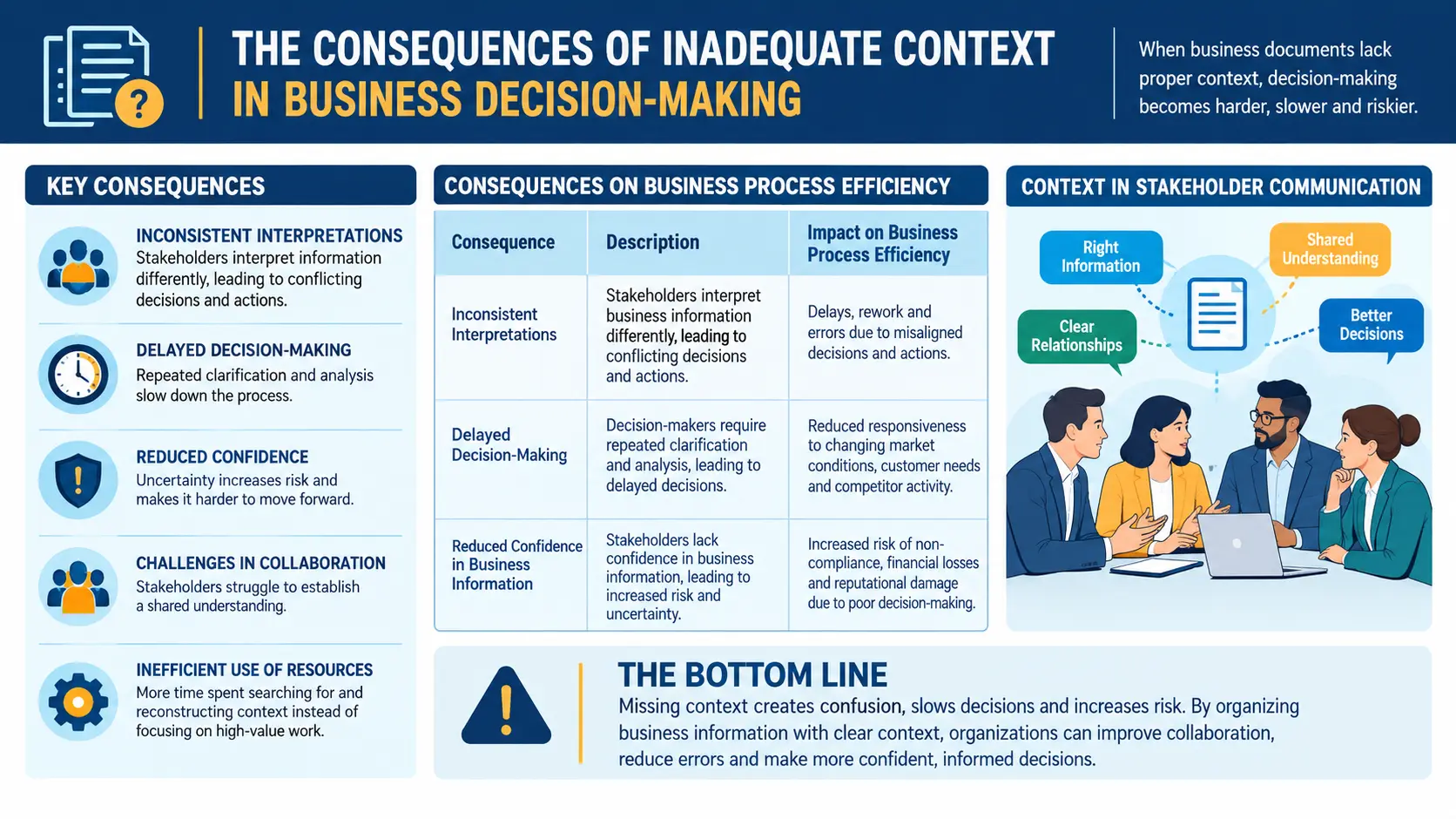
The absence of context in business documents can have significant consequences, affecting not only the decision-making process but also the overall efficiency and effectiveness of an organization. By prioritizing the development of a structured approach to information organization and ensuring that business documents are properly contextualized and explained, organizations can reduce the risk of inconsistent interpretations, delayed decision-making, and reduced confidence in business information, ultimately leading to better decision-making and improved business outcomes.
Establishing Context: The Cornerstone of Informed Decision-Making
Business documents are the lifeblood of any organization, providing the necessary information for decision-making, strategy development, and operational efficiency. However, the mere existence of these documents does not guarantee that the information they contain will be understood, utilized effectively, or connected to the broader business objectives. Context serves as the critical link that transforms isolated pieces of information into a cohesive, actionable narrative.
The concept of context in business documentation refers to the provision of sufficient background information, explanations, and relationships that enable stakeholders to comprehend not just the content of individual documents, but also their relevance, purpose, and interconnections. By establishing this context, organizations can ensure that their documents contribute meaningfully to decision-making processes, rather than simply adding to the noise of disjointed data.
From an operational perspective, integrating context into business documentation has several critical benefits. It enhances the clarity and accessibility of information, reducing the time and effort required for stakeholders to understand and apply the contents of documents. By making the rationale and evidence behind decisions explicit, context facilitates more informed and transparent decision-making, which can lead to better outcomes and enhanced accountability.
For example, a contextualized decision-making process might involve:
- Defining the problem statement and relevant documents
- Outlining assumptions and potential actions
- Choosing an option based on the available information and providing a clear rationale
The absence of context can lead to misinterpretation or misuse of information. When documents lack clear connections to the broader business strategy or operational activities, stakeholders may draw incorrect conclusions or apply information in inappropriate contexts, leading to suboptimal decisions and potential harm to the organization.
To navigate the complexities of establishing and maintaining context in business documentation, organizations can employ several strategies:
- Implement a centralized document management system that facilitates the tagging, categorization, and linking of related documents.
- Develop and enforce clear guidelines for document creation, including the provision of context through introductory sections, executive summaries, and appendices.
- Establish a culture of transparency and accountability, where decisions and their rationales are openly communicated and subject to review and feedback.
From a technical standpoint, information governance frameworks can support the integration of context into business documentation. These frameworks outline the policies, procedures, and standards for managing information across the organization, including guidelines for metadata creation, document version control, and access permissions.
Maintaining context over time is equally crucial, as business information and documents evolve. This involves regular review and update of documents to ensure they remain relevant and accurate, as well as the implementation of change management processes that capture and communicate alterations to context and content.
Ultimately, connecting business documents to decision-making through context is a multifaceted challenge that requires a strategic approach to information management. By understanding the importance of context and implementing supportive governance frameworks, organizations can unlock the full potential of their business documents, fostering a culture of informed decision-making and driving sustainable success.
A Practical Framework for Adding Context to Business Documents
Implementing contextual documentation practices is crucial for businesses to ensure that their documents provide value beyond mere storage and retrieval. Without context, documents can lead to misunderstandings, misinterpretations, and poor decision-making, ultimately affecting business outcomes. A well-structured framework for adding context to business documents can mitigate these risks and foster a culture of informed decision-making. This section outlines a practical framework for businesses to implement contextual documentation practices, focusing on the relationships between business processes, organizational knowledge, and document organization.
The primary objective of this framework is to provide a step-by-step approach to adding context to business documents, enabling organizations to create a knowledge base that supports informed decision-making. By following this framework, businesses can ensure that their documents are not only accessible but also provide the necessary context for stakeholders to understand the information and make informed decisions. The framework consists of six key components: identifying the purpose of each document, connecting evidence to business decisions, explaining assumptions behind business information, establishing a shared understanding among stakeholders, documenting decision rationale, and maintaining context as documents change.
Clearly defining the purpose of each document is critical in establishing the context of the information contained within. This involves stating the document's objective, scope, and intended audience. For instance, a document outlining a new marketing strategy should clearly state its purpose, such as "to increase brand awareness among the target audience," and provide relevant context, including market research and analysis.
The purpose of a document is not just to convey information, but to provide context that enables stakeholders to make informed decisions. By clearly defining the purpose of each document, businesses can ensure that their documents are focused, relevant, and provide value to the organization
Connecting evidence to business decisions involves linking relevant data and information to support business decisions. This includes providing context on the sources of the information, methodology used to collect and analyze the data, and any assumptions made during the decision-making process. For example, a document outlining a new product launch should provide context on the market research conducted, customer feedback, and sales projections to support the decision to launch the product.
Explaining assumptions behind business information is essential in ensuring that stakeholders understand the context of the information. This involves clearly stating any assumptions made during the collection, analysis, and interpretation of data, as well as providing context on the limitations of the information. For instance, a document outlining a new business strategy should provide context on the assumptions made regarding market trends, customer behavior, and competitor activity.
Establishing a shared understanding among stakeholders involves creating a common language and framework for understanding the context of business documents. This includes defining key terms, establishing a taxonomy for categorizing documents, and providing training and support for stakeholders to ensure they understand the context of the information. For example, a document outlining a new project plan should provide context on the project's objectives, scope, and timelines, as well as define key terms and acronyms used throughout the document.
Documenting decision rationale involves capturing the reasoning and justification behind business decisions. This includes providing context on the factors that influenced the decision, such as market trends, customer feedback, and competitor activity, as well as documenting any alternative options considered and the reasons for selecting the chosen course of action. For instance, a document outlining a new investment strategy should provide context on the factors that influenced the decision, such as market research, financial analysis, and risk assessment.
Maintaining context as documents change involves ensuring that the context of business documents is preserved as the documents evolve over time. This includes updating documents to reflect changes in the business environment, such as changes in market trends, customer needs, or competitor activity, as well as ensuring that the context of the information is preserved during the document's lifecycle. For example, a document outlining a new business strategy should be updated regularly to reflect changes in the market, customer feedback, and competitor activity, and should provide context on the reasoning behind any changes made to the strategy.
By implementing this framework, businesses can create a knowledge base that supports informed decision-making, fosters a culture of transparency and accountability, and provides context for stakeholders to understand the information and make informed decisions. As businesses continue to evolve and grow, prioritizing the implementation of contextual documentation practices is crucial for remaining competitive and achieving objectives. The ability to create and maintain context-rich documents will become a key differentiator for businesses, enabling them to make informed decisions, build trust with stakeholders, and drive long-term success.
This checklist helps businesses improve the context of their documentation, enabling more informed decision-making and enhanced stakeholder communication. It focuses on information clarity, decision support information, and stakeholder communication.
- Establish a clear understanding of the purpose and scope of each document
- Identify and document the relationships between related documents and business processes
- Develop a standardized approach to organizing and explaining business information
- Implement a system for maintaining and updating document context over time
- Foster a culture of transparency and accountability through documentation
Context is crucial in business documentation. Without it, even well-organized documents can fail to provide the necessary insight for informed decision-making. By implementing these steps, businesses can improve the clarity and usefulness of their documentation, leading to better decision-making and more effective stakeholder communication.
Understanding the Purpose and Scope of Documents
A clear understanding of the purpose and scope of each document is essential. This involves identifying the specific business objectives, operational activities, or decisions the document supports. By establishing this context, businesses can ensure their documents are focused, relevant, and provide the necessary information for stakeholders to make informed decisions.
A well-defined purpose and scope enable documents to be tailored to the business's specific needs, reducing unnecessary complexity and improving clarity.
Understanding the purpose and scope of documents is critical for ensuring business processes are properly supported and decisions are made with the best available information. This involves documenting relationships between related documents and business processes and establishing a standardized approach to organizing and explaining business information.
Documenting Relationships and Standardizing Approaches
Documenting relationships between related documents and business processes provides context and facilitates informed decision-making. This involves identifying key dependencies, assumptions, and evidence that underpin business decisions and ensuring they are clearly explained and easily accessible. Standardizing approaches to organizing and explaining business information reduces complexity, improves consistency, and enhances documentation usefulness.
Tables and visual aids can effectively document relationships and standardize approaches, presenting complex information clearly and concisely. For example, a table might outline key documents and business processes involved in a decision-making process, highlighting relationships and specific information each provides.
Maintaining and Updating Document Context
Maintaining and updating document context over time ensures business information remains relevant, accurate, and useful. This involves establishing a system for regularly reviewing and updating documents and reflecting changes to business processes and decisions in the documentation. By implementing such a system, businesses can reduce the risk of outdated or inaccurate information and ensure their documentation continues to provide necessary context and insight.
Maintaining and updating document context is essential for building trust and ensuring stakeholders have access to the same information. By providing clear, concise, and up-to-date documentation, businesses can facilitate more effective communication and collaboration, ultimately leading to better decision-making and more successful outcomes.
Fostering a Culture of Transparency and Accountability
Fostering a culture of transparency and accountability through documentation builds trust and ensures business information is used effectively. This involves providing clear and concise documentation and ensuring stakeholders have access to the information they need to make informed decisions. By implementing a culture of transparency and accountability, businesses can reduce miscommunication, improve stakeholder engagement, and drive better decision-making and more successful outcomes.
Improving the context of business documentation enhances decision-making, stakeholder communication, and overall business success. By following this checklist and implementing a standardized approach to documenting business information, businesses can provide the necessary clarity and insight for informed decision-making, ultimately driving better outcomes and more effective stakeholder communication. Implementing these strategies will directly impact the quality of business information, leading to more informed decision-making and improved stakeholder trust.
Frequently Asked Questions
How does missing context increase business risk?
Missing context can cause stakeholders to misinterpret information, overlook dependencies, or make decisions based on incomplete data. These problems can contribute to operational errors, compliance issues, financial losses, and reputational damage.
What is the difference between document organization and document context?
Document organization makes information easier to locate, categorize, and maintain. Document context explains the purpose, relevance, assumptions, and relationships behind that information. Businesses need both to help decision-makers understand documents and use them appropriately.
How does document context improve communication among stakeholders?
Shared context helps stakeholders interpret business information consistently and understand how it relates to their responsibilities and decisions. Clear explanations, documented assumptions, and identifiable evidence reduce misunderstandings and help teams coordinate their actions.
What information should be included to make a business document useful for decision-making?
A decision-ready business document should identify its purpose, relevance to the business decision, relationships to other documents, underlying assumptions, dependencies, supporting evidence, and any limitations in the available information. This helps stakeholders understand both the content and its significance.
How can businesses add context to their documents?
Businesses can add context by clearly stating each document's purpose and scope, connecting related documents, identifying supporting evidence, documenting assumptions and dependencies, and explaining the rationale behind decisions. They should also review and update contextual information as business conditions change.
What is a practical framework for evaluating context in business documents?
Businesses can evaluate document context using five criteria: purpose, relevance, relationships, assumptions, and dependencies. These criteria help determine whether a document explains why it exists, how it supports a decision, how it connects to other information, and what conditions affect its interpretation.
How does missing context in business documents affect decision-making?
Missing context can lead to inconsistent interpretations, delayed decisions, repeated analysis, and reduced confidence in business information. Decision-makers may rely on incomplete information or assumptions, increasing the risk of errors and poor business outcomes.
How can businesses prevent outdated document context from leading to poor decisions?
Businesses should regularly review documents, update explanations when business conditions change, and preserve the reasoning behind important decisions. Assigning document ownership and establishing consistent review practices help ensure that stakeholders rely on relevant, accurate information.
Why is context important in business documents?
Context helps stakeholders understand the purpose, relevance, and relationships of information in business documents. It enables them to interpret information accurately, evaluate evidence, understand assumptions, and make informed business decisions.
How do relationships between business documents improve decision-making?
Document relationships show how different pieces of information connect and contribute to a business decision. For example, linking a sales report to the marketing campaign it evaluates helps stakeholders understand performance in context rather than interpreting the report in isolation.