

How Can Organizations Turn Knowledge Into Business Intelligence?
Organizational knowledge management helps businesses organize documents, preserve institutional knowledge, and provide the context needed for better decisions. A structured approach to information management can reduce operational friction, improve business intelligence, and strengthen decision-making.
published:

- 28
- 833
- 49
The Importance of Organizational Knowledge Management
Organizational knowledge management is the process by which an organization creates, shares, uses, and manages its institutional knowledge to achieve its objectives. Effective organizational knowledge management is critical for business success because it enables companies to make informed decisions, reduce operational friction, and improve collaboration among employees. As institutional knowledge grows, so does the complexity of managing it, making it essential to implement a structured approach to knowledge management.
The accumulation of documents does not automatically create organizational intelligence. In fact, a large volume of unorganized information can lead to information overload, making it difficult for employees to find, interpret, and apply relevant knowledge. This highlights the need for organizations to focus on creating a knowledge management system that provides context, structure, and consistent practices for interpreting and applying information.
Organizational knowledge becomes valuable when people can understand not only what information exists, but why it matters to the business and how different pieces of information relate to one another.
This quote underscores the importance of providing context to organizational knowledge. Without context, information is merely a collection of data points that lack meaning and relevance. By providing context, organizations can help employees understand the significance of information, how it relates to their work, and how it contributes to the overall goals of the organization.
Effective organizational knowledge management reduces the time spent on reconstructing existing knowledge. When important knowledge is consistently captured, categorized, connected, and maintained, employees can focus on higher-value tasks such as decision-making, innovation, and customer service. This leads to improved productivity, reduced costs, and enhanced competitiveness.
Risks of Inadequate Organizational Knowledge Management
The loss of institutional knowledge when employees leave the organization or change roles is a significant risk factor associated with inadequate organizational knowledge management. This can occur when critical information is not documented or shared, making it difficult for new employees to access and apply existing knowledge. To mitigate this risk, organizations must implement a knowledge management system that captures, stores, and shares knowledge in a way that is accessible and usable by all employees.
- Lack of standardization in knowledge management practices
- Insufficient training and support for employees
- Inadequate technology infrastructure to support knowledge management
- Failure to capture and document critical information
Inadequate organizational knowledge management can have severe consequences, including repeated work, slower decision-making, inconsistent execution, and the loss of critical information. To avoid these consequences, organizations must prioritize knowledge management and implement a structured approach that provides context, structure, and consistent practices for interpreting and applying information.
A framework for implementing effective organizational knowledge management includes several key components, such as knowledge capture, knowledge sharing, and knowledge application. By understanding the importance of each component and how they relate to one another, organizations can create a comprehensive knowledge management system that supports their business objectives. The following checklist provides a starting point for implementing a knowledge management framework:
- Establish clear goals and objectives for knowledge management
- Develop a knowledge management strategy and plan
- Implement a technology infrastructure to support knowledge management
- Provide training and support for employees
- Monitor and evaluate the effectiveness of knowledge management practices
Organizational knowledge management is critical for business success because it enables companies to make informed decisions, reduce operational friction, and improve collaboration among employees. By understanding the importance of context, structure, and consistent practices in knowledge management, organizations can create a comprehensive system that supports their business objectives and provides a competitive advantage.
Effective organizational knowledge management requires a deep understanding of the organization's goals, objectives, and critical information needs. By analyzing these factors and implementing a tailored knowledge management approach, organizations can unlock the full potential of their institutional knowledge and achieve sustained success in a complex and competitive business environment.
Learn More About Organizational Knowledge Management
Frameworks for Turning Documents into Intelligence
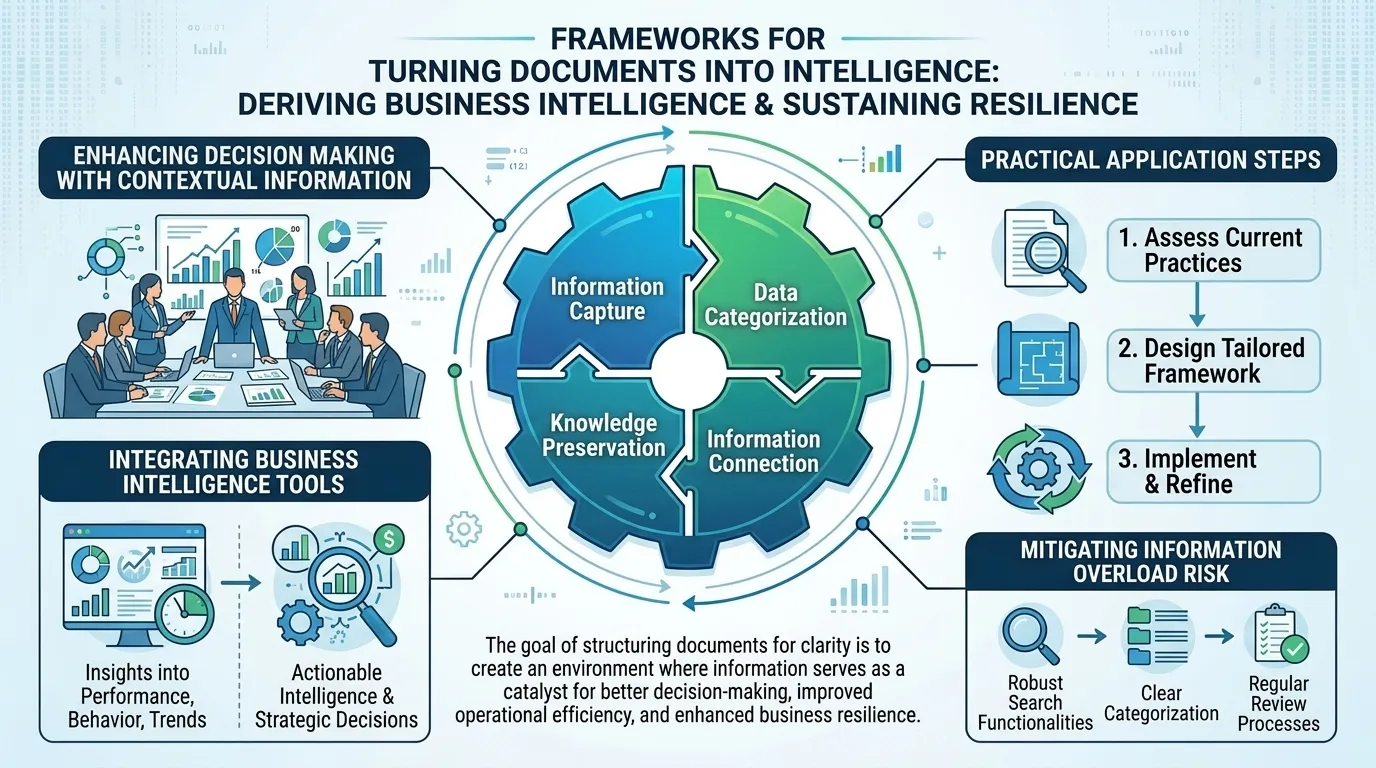
Effective information management is crucial for organizations seeking to derive actionable business intelligence from their documents. The sheer volume of documents, reports, and data that businesses accumulate can be overwhelming, making it challenging to extract meaningful insights without a structured approach. Implementing frameworks that categorize, connect, and maintain information in a way that supports informed decision-making and reduces operational friction is essential.
From an organizational perspective, the ability to turn documents into intelligence hinges on establishing clear, consistent practices for information capture, categorization, and connection. This requires more than just accumulating documents; it demands a thoughtful approach to how information is organized, accessed, and applied. The information management framework is a critical tool in this endeavor, providing a structured methodology for managing the lifecycle of information from creation through disposal.
A well-designed information management framework should include several key components: information capture, data categorization, information connection, and knowledge preservation. Each of these elements plays a vital role in ensuring that information is not only accessible but also meaningful and applicable to the business needs at hand.
| Component | Description |
|---|---|
| Information Capture | The process of collecting and documenting organizational knowledge in a systematic way. |
| Data Categorization | Organizing information into categories that reflect business needs and processes. |
| Information Connection | Linking related pieces of information to provide context and facilitate understanding. |
| Knowledge Preservation | Maintaining and updating information over time to ensure its continued relevance and accuracy. |
The implementation of such a framework can significantly enhance an organization's ability to derive business intelligence from its documents. By structuring information in a clear, consistent manner, businesses can reduce the time spent searching for relevant data, improve decision-making through better-informed choices, and mitigate the risk of knowledge loss when employees leave or roles change.
For example, a structured framework might involve:
- Identifying key information sources
- Categorizing data by business process
- Connecting related information assets
- Establishing a regular review cycle
Practical Application: Enhancing Decision Making with Contextual Information
One of the primary benefits of structuring documents for clarity is the enhancement of decision-making processes. When information is well-organized and easily accessible, leaders can make more informed decisions by considering a broader context of relevant data. This not only improves the quality of decisions but also reduces the time required to make them, as less effort is spent searching for and verifying information.
A critical aspect of this approach is the integration of business intelligence tools and methodologies that can analyze structured information to provide insights into business performance, customer behavior, market trends, and other critical areas. By leveraging these tools in conjunction with a well-structured information management framework, organizations can turn their documents into actionable intelligence that drives strategic decisions and operational improvements.
To further illustrate the application of these frameworks, consider the following steps:
- Assess current information management practices
- Design a tailored information management framework
- Implement and refine the framework
The implementation of such frameworks also carries the risk of information overload, where the sheer volume of structured data becomes difficult to navigate. To mitigate this risk, organizations must ensure that their information management strategies include robust search functionalities, clear categorization systems, and regular review processes to maintain the relevance and accuracy of the information.
Ultimately, the goal of structuring documents for clarity is to create an environment where information serves as a catalyst for better decision-making, improved operational efficiency, and enhanced business resilience. By adopting and adapting frameworks that prioritize the capture, categorization, connection, and preservation of knowledge, organizations can unlock the full potential of their documents, turning them into a powerful asset that drives growth, innovation, and success.
As businesses continue to accumulate vast amounts of data, the importance of structuring this information in a way that supports clarity, accessibility, and applicability will only grow. The frameworks and strategies outlined here provide a foundation for achieving these goals, but their successful implementation depends on a deep understanding of the organization's specific needs, challenges, and objectives.
Learn More About Information Management Frameworks
Preserving Institutional Knowledge: A Strategic Imperative
Institutional knowledge is the lifeblood of any organization, encompassing the collective expertise, experience, and information that drive business decisions and operations. However, this valuable asset is often at risk due to employee turnover, lack of documentation, and inadequate knowledge management strategies. The consequences of losing institutional knowledge can be severe, resulting in decreased productivity, poor decision-making, and compromised competitiveness.
The preservation of institutional knowledge requires a deliberate approach, one that goes beyond merely storing documents and data. It demands a deep understanding of the organization's information ecosystem, including the relationships between different pieces of information, the context in which they are used, and the people who rely on them. By implementing effective knowledge management strategies, organizations can mitigate the risks associated with institutional knowledge loss.
A comprehensive knowledge management framework is essential for preserving institutional knowledge. This framework should include components such as knowledge capture, storage, retrieval, and sharing, as well as mechanisms for updating and maintaining the accuracy of the information.
Strategies for Preserving Institutional Knowledge
Several strategies can be employed to preserve institutional knowledge, including:
- Developing a knowledge management plan that outlines the organization's approach to capturing, storing, and sharing information
- Implementing a document management system that provides a centralized repository for storing and retrieving documents
- Creating a collaborative platform for sharing knowledge and expertise
- Establishing a mentoring program that pairs experienced employees with newer staff members to transfer knowledge and skills
- Conducting regular knowledge audits to identify gaps and areas where information is at risk of being lost
These strategies can be tailored to meet the specific needs of an organization, taking into account factors such as industry, size, and culture.
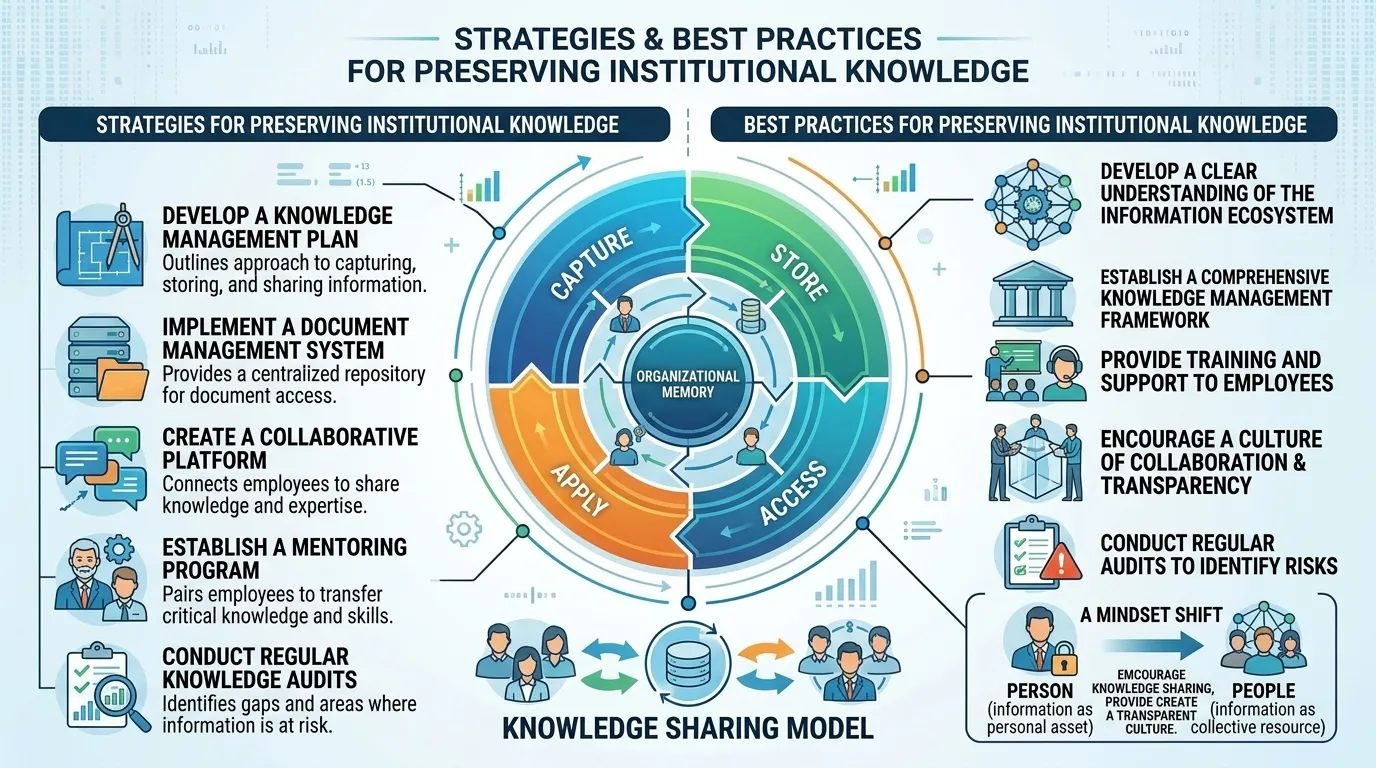
A knowledge sharing model can be used to facilitate the transfer of information between employees, providing a structured approach to capturing, storing, and retrieving knowledge.
Best Practices for Preserving Institutional Knowledge
Several best practices can be employed to preserve institutional knowledge, including:
- Developing a clear understanding of the organization's information ecosystem
- Establishing a comprehensive knowledge management framework
- Providing training and support to employees on knowledge management practices and tools
- Encouraging a culture of collaboration and transparency
- Conducting regular audits to identify gaps and areas where information is at risk of being lost
By following these best practices, organizations can develop a robust approach to preserving institutional knowledge, ensuring the long-term viability and competitiveness of the business.
Decision-Ready Information: The Role of Context in Business Intelligence
Business decisions are only as good as the context in which they are made. In a fast-paced, data-driven world, organizations seek ways to improve their decision-making processes, and context plays a critical role. Business Decision Intelligence (BDI) relies on high-quality, relevant information that is properly contextualized to support informed decision-making.
The lack of context can lead to issues like misinterpretation of data, incorrect assumptions, and poor decision-making. When information is not properly contextualized, stakeholders may struggle to understand its relevance, accuracy, or reliability, leading to a breakdown in trust and confidence in the decision-making process. Inadequate context also increases the risk of decisions based on incomplete or inaccurate information, which can have far-reaching consequences.
- Information Context
- refers to the circumstances, conditions, and background information that provide meaning and relevance to data. This includes temporal, spatial, organizational, and relational aspects that contribute to a deeper understanding of the information being considered.
Context is crucial in business intelligence. When decision-makers have access to contextualized information, they can better evaluate its relevance, accuracy, and reliability, leading to more informed decisions. Context also helps establish a clear understanding of relationships between different pieces of information, facilitating the identification of patterns, trends, and correlations that might otherwise go unnoticed.
Understanding Contextual Relationships
To appreciate the role of context in decision-ready information, it's essential to understand various types of contextual relationships within an organization. These include:
- Temporal context: time-related aspects of information, such as creation date, update frequency, and relevance timeline.
- Spatial context: geographical or physical location of the information, impacting its relevance and applicability.
- Organizational context: structural, cultural, and procedural aspects influencing how information is created, shared, and used.
- Relational context: connections between different pieces of information, such as relationships between data entities, processes, or stakeholders.
Integrating these contextual relationships is critical to creating a comprehensive understanding of the information being considered. By recognizing and analyzing these relationships, organizations can develop a more nuanced appreciation for the complexities involved in decision-making, ultimately leading to better-informed decisions that drive business success.
A Framework for Contextualizing Information
To facilitate contextualization, organizations can employ a framework considering various types of contextual relationships. This framework provides a structured approach to evaluating and integrating context:
| Contextual Element | Description |
|---|---|
| Temporal Context | Evaluate time-related aspects, including creation date, update frequency, and relevance timeline. |
| Spatial Context | Assess geographical or physical location, considering factors like regional relevance and cultural nuances. |
| Organizational Context | Analyze structural, cultural, and procedural aspects influencing information creation, sharing, and use. |
| Relational Context | Examine connections between different pieces of information, including relationships between data entities, processes, or stakeholders. |
By applying this framework, organizations can systematically evaluate and integrate context into their decision-making processes, leading to more informed decisions. The ability to contextualize information effectively is a critical component of Business Decision Intelligence, enabling organizations to navigate complex decision-making scenarios with confidence.
Checklist for Ensuring Contextualized Information
To ensure information is properly contextualized, organizations can use the following checklist:
- Evaluate temporal context, considering creation date and update frequency.
- Assess spatial context, taking into account geographical or physical location.
- Analyze organizational context, including structural, cultural, and procedural aspects.
- Examine relational context, identifying connections between different pieces of information.
- Integrate contextual elements into the decision-making process using a framework like the one outlined earlier.
By following this checklist and applying the framework for contextualizing information, organizations can ensure their decision-making processes are informed by high-quality, relevant, and properly contextualized information. As data volume and complexity grow, the importance of context in business intelligence will increase, making it essential for organizations to prioritize developing robust contextualization capabilities.
Foundational Principles of Knowledge Management
Effective knowledge management is crucial for informed decision-making and operational efficiency in modern organizations. Executives must navigate a complex landscape of information silos, disparate data sources, and competing priorities to harness the collective intelligence of their teams. Developing a comprehensive toolkit that integrates proven strategies, frameworks, and best practices for knowledge management is essential to address these challenges.
A significant risk factor in implementing a knowledge management system is the potential for information overload, leading to decreased productivity and increased operational friction. To balance the need for comprehensive information capture with the imperative of maintaining a lean decision-making process, executives should adopt a structured approach to knowledge management that emphasizes context, clarity, and relevance.
A well-designed knowledge management system relies on several foundational principles: creating a shared understanding of key concepts, establishing clear information taxonomies, and developing standardized processes for information capture, storage, and retrieval. By applying these principles, organizations can reduce complexity, improve decision-making quality, and enhance their resilience in the face of change or disruption.
Knowledge management requires a deep understanding of the organizational context in which information is created, shared, and applied. Effective knowledge managers must navigate the social, cultural, and technical dimensions of their organizations to unlock the full potential of collective intelligence.
Implementing a knowledge management system poses the challenge of balancing the demands of different stakeholder groups, each with unique information requirements and priorities. The Knowledge Management Maturity Model provides a structured approach to assessing organizational readiness, identifying areas for improvement, and developing targeted strategies for knowledge management.
- Define a clear vision and strategy for knowledge management aligned with organizational objectives
- Establish a governance structure to oversee knowledge management initiatives and ensure accountability
- Develop a comprehensive information architecture that integrates disparate data sources and systems
- Implement standardized processes for information capture, storage, and retrieval
- Foster a culture of collaboration and knowledge-sharing across organizational boundaries
By applying this framework and addressing the unique needs and priorities of different stakeholder groups, executives can create a tailored knowledge management system that leads to improved decision-making, enhanced operational efficiency, and increased competitiveness.
A Practical Toolkit for Executives
To support effective knowledge management practices, executives need a practical toolkit with strategies, frameworks, and templates. The Knowledge Management Checklist provides a comprehensive guide to assessing organizational readiness, identifying areas for improvement, and developing targeted strategies for knowledge management.
- Assess organizational information assets and systems thoroughly
- Identify key stakeholders and their information requirements
- Develop a clear vision and strategy for knowledge management
- Establish a governance structure to oversee knowledge management initiatives
- Implement standardized processes for information capture, storage, and retrieval
By applying this checklist and the Knowledge Management Maturity Model, executives can develop a comprehensive understanding of their organization's knowledge management capabilities and identify areas for improvement. This informs the development of targeted strategies and initiatives to enhance knowledge management practices and drive business success.
Applying knowledge management principles and frameworks significantly impacts organizational performance, enabling businesses to make informed decisions, respond effectively to change, and drive innovation and growth. Executives must consider the complex interplay between social, cultural, and technical factors that influence information creation, sharing, and application when creating a culture of knowledge-sharing and collaboration.
From a business intelligence perspective, effective knowledge management is critical to unlocking the full potential of organizational data assets. Integrating knowledge management principles with business intelligence frameworks helps executives develop a comprehensive understanding of their organization's information landscape and make informed decisions about where to focus their efforts.
Frequently Asked Questions
How can businesses preserve institutional knowledge when employees leave?
Businesses can preserve institutional knowledge by identifying critical information, documenting it, sharing it, and regularly reviewing it for accuracy and relevance. Knowledge management plans, knowledge audits, mentoring, collaborative knowledge sharing, and structured information practices can help reduce the risk of losing important knowledge when employees leave or change roles.
Why is context important when using business information for decisions?
Context gives business information meaning and relevance. Temporal, spatial, organizational, and relational context helps decision-makers evaluate information, understand how different pieces of information relate, and reduce the risk of decisions based on incomplete or inaccurate information.
What information should organizations preserve as institutional knowledge?
Organizations should preserve critical information needed to support business decisions and operations, including important knowledge that may otherwise remain with individual employees. The article emphasizes understanding the organization's information ecosystem and identifying gaps where important information is at risk of being lost.
How can organizations turn documents into business intelligence?
Organizations can turn documents into business intelligence by systematically capturing, categorizing, connecting, and preserving information. Structuring documents around business needs provides context that helps decision-makers identify relevant information, understand relationships, and make better-informed decisions.
How can organizations reduce information overload while improving knowledge management?
Organizations can reduce information overload by emphasizing context, clarity, and relevance rather than simply capturing more information. Clear categorization, structured information practices, regular reviews, and a focus on business needs help ensure that information remains useful and manageable.
How should businesses organize information to reduce operational friction?
Businesses should organize information according to business processes and information needs, rather than simply accumulating documents. A structured approach should capture important knowledge, categorize it consistently, connect related information, and maintain it over time so employees can find and apply what they need without reconstructing existing knowledge.
How can executives assess their organization's knowledge management capabilities?
Executives can assess knowledge management capabilities by evaluating organizational information assets, identifying stakeholder information requirements, establishing a knowledge management strategy and governance structure, and reviewing how effectively information is captured, stored, retrieved, shared, and maintained.
How does organizational knowledge management improve decision-making?
Organizational knowledge management improves decision-making by making relevant information easier to find, understand, and apply. When information is consistently captured, categorized, connected, and maintained, decision-makers spend less time reconstructing existing knowledge and have more context for evaluating decisions.